When Arc mainnet launches, the most important question will not be how many existing applications can move onto another blockchain.
It will be what new kinds of economic activity become possible when the internet gains infrastructure designed for programmable money, machine-speed coordination and autonomous actors.
Circle describes Arc as the Economic Operating System for the internet. Its broader agentic-economy strategy gives AI agents tools to hold value, discover services and transact programmatically with USDC. Circle Gateway Nanopayments adds a rail for high-frequency, sub-cent payments that would be uneconomical if every interaction required a separate on-chain transaction.
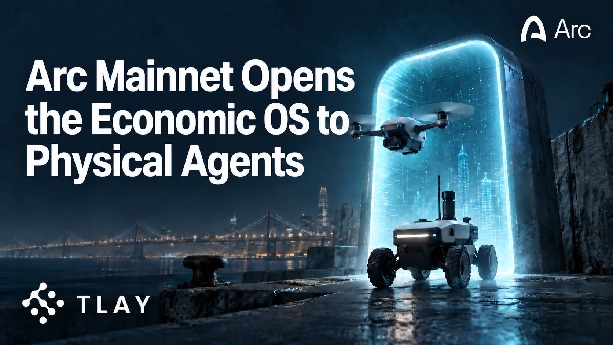
On September 17, the Arc mainnet launch drone to power nanopayments showcase made the next frontier visible.
The buyer was not a browser or a software agent calling an API. It was a physical drone. The seller was an Arkreen eCandle supplying a measurable physical resource: energy. TLAY connected that physical interaction to Circle and Arc’s financial infrastructure.
From the agentic economy to the physical agentic economy
Most agentic-payment examples begin inside software.
An AI agent discovers a service, receives a machine-readable price, signs a payment and retrieves a digital result. This is an important new market, and Circle’s Agent Stack, USDC, Gateway Nanopayments and support for protocols such as x402 are designed for it. Physical AI agents add another layer of difficulty.
A drone, robot, vehicle or sensor must connect economic logic to events in the physical world. It needs to answer questions software-only agents can often avoid:
- What physical resource was actually delivered?
- How was it measured?
- Which device requested the payment?
- Which device authorised it?
- What happens when connectivity is intermittent?
- How much exposure can exist before settlement?
- Which actions should happen locally, and which should reach the chain?
The financial rail is essential, but it is not enough on its own. A physical agent needs an execution layer that connects identity, metering, policy and secure signing to that rail. This is the layer TLAY brought to the Arc mainnet showcase.
What happened in the drone demonstration
The drone landed on an Arkreen eCandle and began drawing power.
The devices established a Bluetooth Low Energy session. The eCandle measured usage and published payment requirements. Every five seconds, the drone used its on-device key to sign an EIP-3009 USDC payment authorisation.
The eCandle collected those authorisations and submitted them in batches through TLAY Hashanchor for settlement using Circle Gateway Nanopayments.
Those high-frequency authorisations were not individual Arc transactions. That separation is the point. Circle Gateway enables gas-free, machine-scale authorisations and batched settlement, so every small unit of physical usage does not need to become a separate blockchain transaction.
When the seller chose to move cleared value on-chain, the eCandle signed a different EIP-712 intent. The resulting USDC transaction was then publicly verifiable on Arc mainnet.
One physical session therefore connected:
- a measured energy event;
- an embedded buyer identity;
- a machine-readable price;
- a constrained payment policy;
- high-frequency USDC authorisations;
- batched settlement through Circle Gateway;
- final on-chain value on Arc.
Circle and Arc provide the financial OS
Circle’s infrastructure answers the financial questions.
USDC provides programmable digital value. Circle Gateway Nanopayments enables gas-free authorisations as small as a millionth of a dollar and settles net positions in batches. x402 provides an open way for a seller to communicate payment requirements and for a buyer to return a signed payment payload. Arc provides an enterprise-grade on-chain environment intended to support internet-native economic activity.
Together, these components create the financial substrate for autonomous economic actors.
TLAY provides the physical-agent execution layer
TLAY’s stack answers the physical questions.
It connects a meter to a price. It gives a device an economic identity. It allows a buyer and seller to discover each other over a local protocol. It enforces device-side policy before signing. It creates evidence close to the physical event, collects proofs during intermittent connectivity and hands economically meaningful records to the Circle/Arc infrastructure.
The division is complementary:
| Circle / Arc | TLAY |
|---|---|
| USDC value and liquidity | Physical resource pricing and usage mapping |
| Gateway Nanopayments and settlement | Edge payment requests and proof collection |
| x402-compatible payment negotiation | Physical-device adapters beyond conventional HTTP |
| Agent financial infrastructure | Embedded identity, device policy and secure signing |
| Arc on-chain execution and finality | Hardware-to-Arc event and proof path |
Circle and Arc make autonomous financial activity possible at internet scale. TLAY makes it possible for physical machines to participate without pretending that a robot is merely a web browser with wheels.
Why the combination matters
Physical machines generate a different economic rhythm from conventional commerce.
They consume resources continuously. Their interactions may be worth fractions of a cent. They operate under local safety constraints. They may need to authorise thousands of events before an on-chain state change is useful.
Circle Gateway’s batching model and TLAY’s edge-event model fit that rhythm.
TLAY preserves a signed relationship between the physical event and the payment authorisation. Gateway makes those authorisations economically viable at machine scale. Arc gives cleared value a programmable, publicly verifiable home.
The drone show is therefore more than a visual celebration of a network launch. It is a reference architecture for extending Arc’s Economic OS beyond software agents and into Physical AI.
A category TLAY intends to build
TLAY’s opportunity is not to claim ownership of every layer. It is to become the specialist that Circle, Arc and their ecosystem call when an autonomous economic actor has motors, sensors, batteries or a physical job to perform.
Following the launch showcase, TLAY is proposing the Physical Agent Payment Reference Stack for Arc: an open architecture and pilot programme for connecting physical resources and autonomous devices to Circle Gateway Nanopayments, USDC and Arc.
The stack will focus on:
- embedded buyer and seller identities;
- physical-resource payment requirements;
- device-side policy and spending controls;
- secure EIP-3009 authorisation;
- batch and facilitator integration;
- settlement and Arc proof dashboards;
- reference implementations for drones, robots, chargers, sensors and distributed energy.
The first demonstration used one drone and one energy endpoint. The larger goal is a repeatable way for the Arc ecosystem to bring many classes of physical agents into programmable commerce.
The Arc mainnet moment
Mainnet launches are often measured by technical readiness and initial liquidity. Those are necessary measures.
The longer-term measure is whether a network becomes a place where new economic coordination can actually occur.
On September 17, a drone landing on an eCandle offered one answer: Arc’s Economic OS can extend beyond internet services to physical agents, provided that financial infrastructure and physical execution infrastructure are designed together.
That is the layer TLAY is here to build.