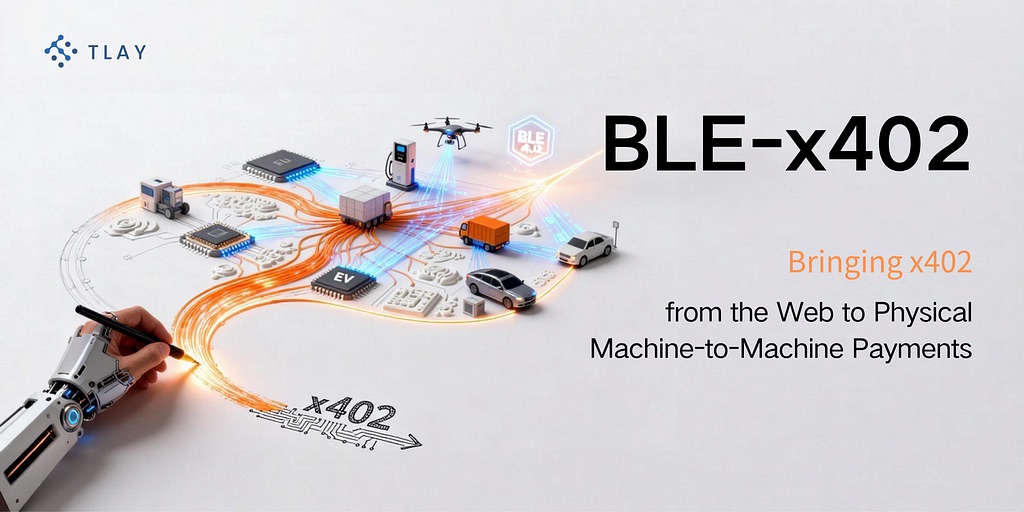
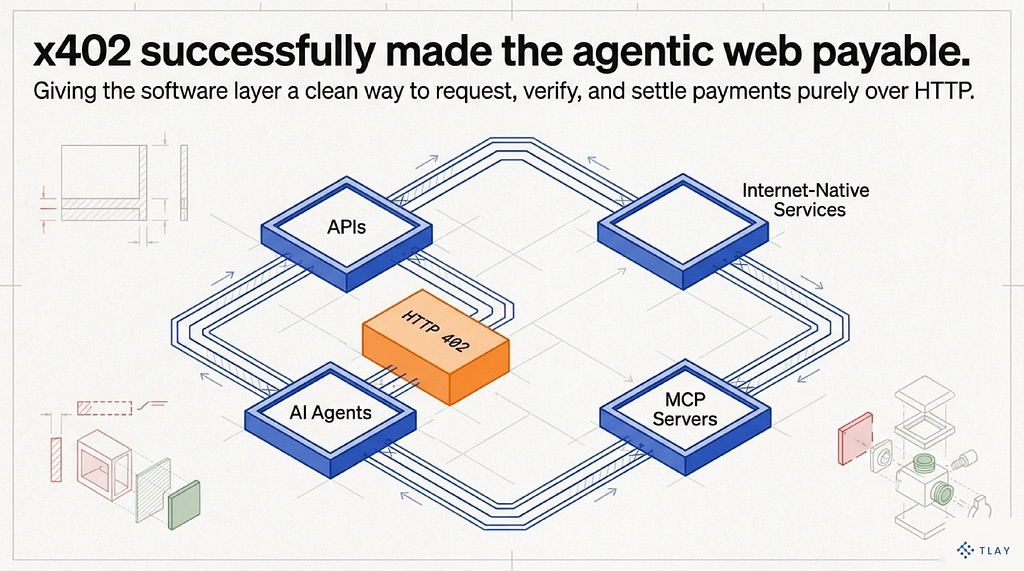
x402 is quickly becoming one of the most important payment primitives for the agentic web. By turning HTTP 402 into a practical payment protocol, x402 gives APIs, AI agents, MCP servers, and internet-native services a clean way to request, verify, and settle payments.
But we believe the same idea should not stop at HTTP.
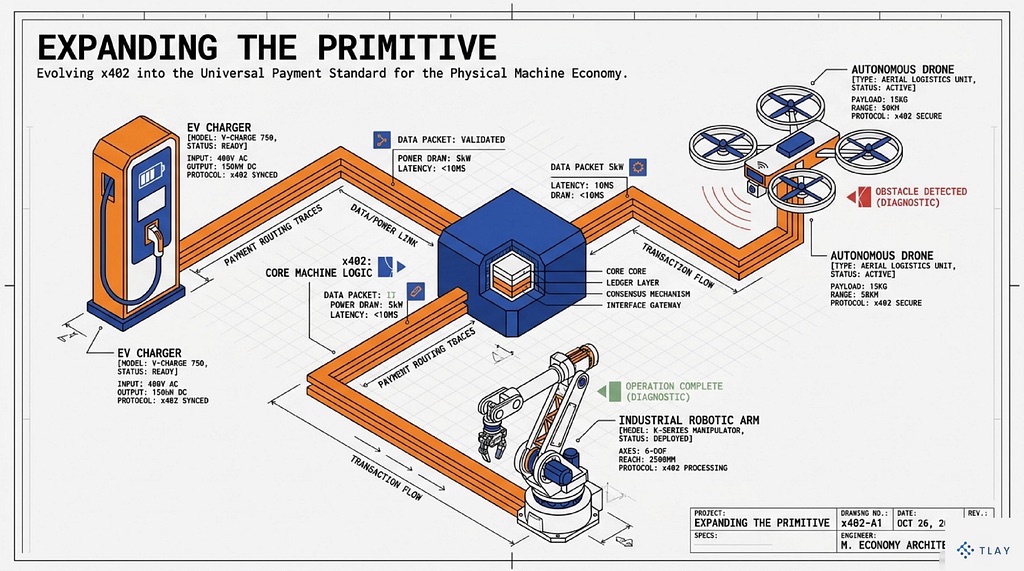
The next wave of autonomous commerce will happen not only between software agents, but also between physical machines.
- EVs will pay chargers.
- Robots will pay docking stations.
- Smart appliances will pay for green energy.
- AI edge devices will pay for local compute or power.
- DePIN devices will pay each other for connectivity, data, energy, and service access.
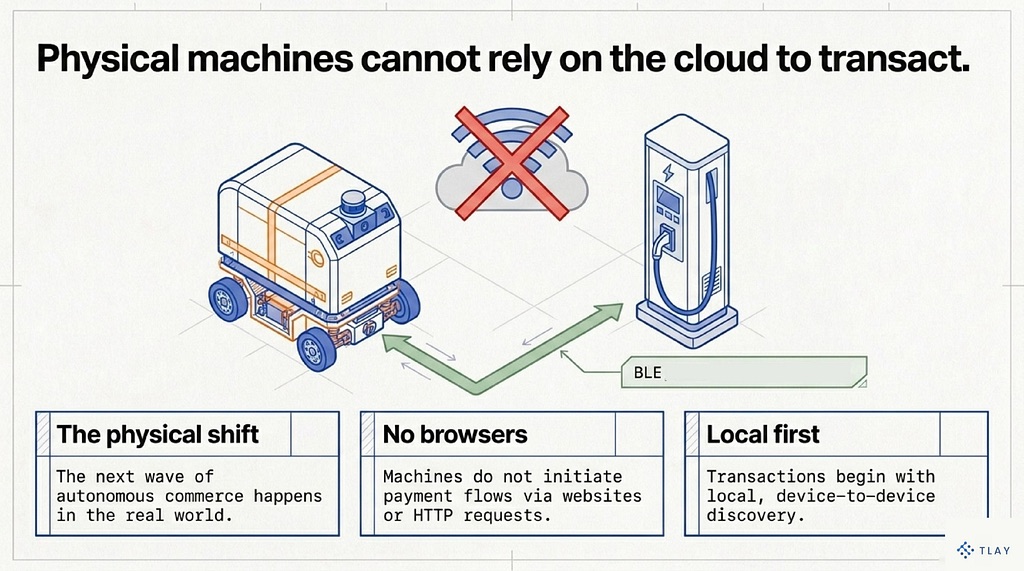
Many of these machines will not start their payment flow with a browser, a website, or even a normal HTTP request.
They will start with local discovery
- Bluetooth Low Energy.
- NFC.
- MQTT.
- LoRaWAN.
- Local device-to-device protocols.
That is why we believe x402 should evolve from an HTTP-native payment protocol into a transport-agnostic payment standard for both the internet and the physical world.
From HTTP-x402 to BLE-x402
In our recent eCandle × Bitaxe demo, we implemented a machine-to-machine nanopayment flow using x402-like semantics over Bluetooth Low Energy.
Related Reading: [eCandle Circle Nanopayments — Running Machine-to-Machine Nanopayments on Circle Gateway Arc] Video Demo: [X/Twitter Post]
The eCandle acts like a local x402 service provider. Instead of returning an HTTP 402 response, it exposes a payment requirement through a BLE GATT characteristic:
- asset: USDC - amount: required energy price - recipient: eCandle / Arkreen account - network: supported settlement rail - resource: physical energy output - validity window: local payment session
The Bitaxe mining device acts like the x402 client. It discovers the eCandle over BLE, reads the payment requirement, signs a USDC payment authorization on-device, and writes the signed payment payload back to the eCandle through BLE.
The eCandle then verifies the payment proof locally. If the proof is valid, the physical service is unlocked: real energy output is delivered to the mining device. The signed proofs can then be batched and settled through an x402-compatible facilitator.
So the full pattern becomes:
- BLE discovery 2. Payment requirement over BLE 3. On-device signing 4. Payment payload over BLE 5. Local verification 6. Physical service unlock 7. Facilitator settlement
That is the key idea behind BLE-x402: same x402 payment semantics, new physical-world transport.
Why This Matters
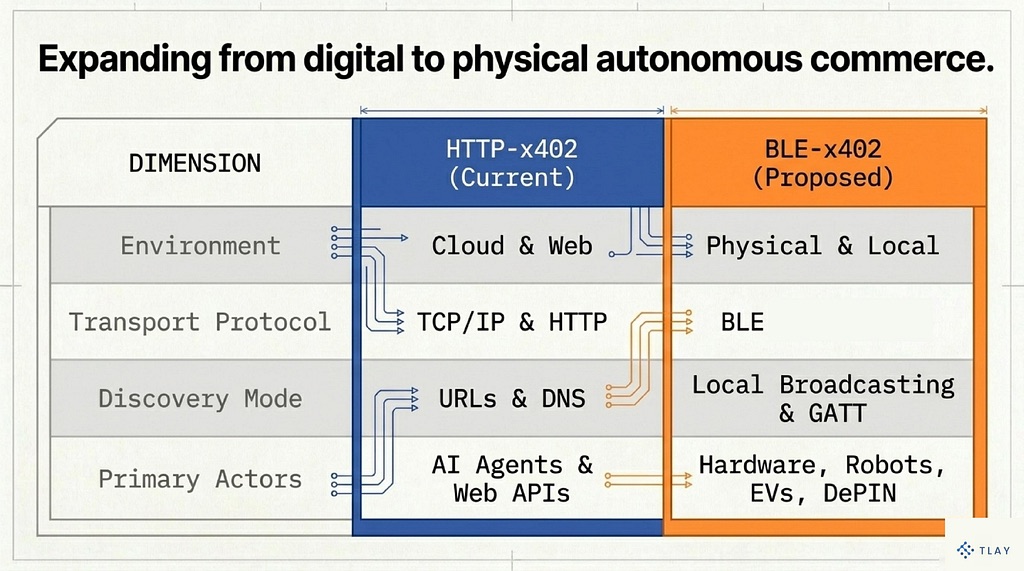
HTTP-x402 makes the web payable. > BLE-x402 could make machines payable.
This matters because the machine economy will not be purely digital. It will be physical, local, and embedded.
For x402 to become the universal payment language for autonomous agents, it should support not only cloud agents and web APIs, but also IoT devices, DePIN hardware, energy devices, EV chargers, smart appliances, robots, edge AI devices, and local machine-to-machine service markets.
A physical device should be able to say:
“Here is the service I can provide.” > “Here is the payment requirement.” > “Send me a signed payment proof.” > “Once verified, I will deliver the service.”
That is the same spirit as x402 — just outside HTTP.
A Proposal for the x402 Ecosystem
We would like to propose a simple direction for the x402 ecosystem: separate x402 into two layers.
x402 Core
The shared payment logic:
- Payment requirement
- Accepted asset
- Amount
- Recipient
- Network
- Validity window
- Signed payment authorization
- Verification
- Settlement
- Facilitator response
x402 Transport Profiles
Different ways to carry the same payment logic:
- HTTP-x402 for APIs, websites, AI agents, and MCP servers
- BLE-x402 for nearby physical devices
- MQTT-x402 for IoT networks
- NFC-x402 for tap-based physical interactions
- LoRaWAN-x402 for low-bandwidth industrial devices
- WebSocket-x402 for real-time agent sessions
The goal is not to replace HTTP-x402.
The goal is to help x402 become the universal payment standard for both digital and physical autonomous systems.
What TLAY Can Contribute
TLAY is building the trust layer for DePIN and the machine economy. Through TLAY BoAT, HashAnchor, and Arkreen’s energy device network, we are exploring how physical machines can hold keys, sign payment authorizations, verify proofs, and unlock real-world services.
We would be excited to contribute to the x402 community:
- A BLE-x402 concept - A BLE GATT payment requirement flow - An embedded signing implementation - A physical M2M payment demo - An x402-compatible facilitator bridge - Learnings from DePIN and energy device environments
If Coinbase, the x402 Foundation, and the wider x402 community believe this direction is valuable, we would be happy to prepare a more detailed technical proposal and contribute a reference implementation.
Closing Thought
x402 started by making HTTP payments practical. Now it has the potential to become something bigger: a payment language for autonomous agents, machines, and physical infrastructure.
HTTP-x402 makes the web payable. > BLE-x402 makes the physical world payable.
Let’s bring x402 from the internet into the machine economy.
TLAY — The Trust Layer for DePIN Website) · X/Twitter) · Medium)