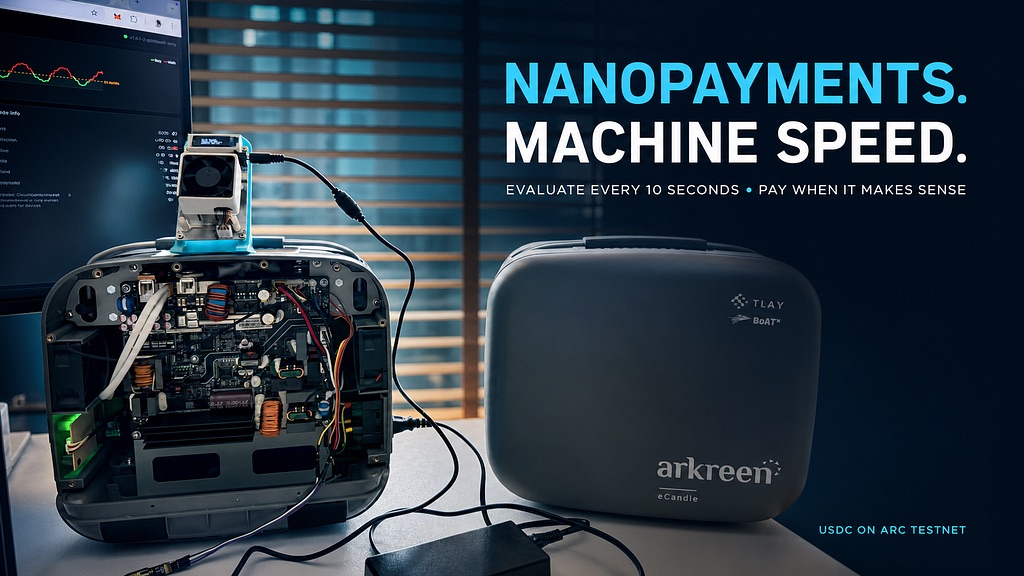
Why the future of stablecoin payments extends beyond software into real-world commerce.
The emerging agentic economy has a compelling premise: autonomous software should be able to participate in economic activity.
An AI agent that can research a task, negotiate a price, purchase a service, and settle a transaction can operate with greater independence than one that depends on a human to approve every action.
Stablecoins make this vision increasingly practical. They provide a programmable form of money that can move through digital systems without relying on payment workflows originally designed around human interfaces.
Most early examples follow a familiar pattern: agents paying for model inference, API access, cloud computing, proprietary datasets, or services provided by other agents.
These are important developments. They establish the foundations of autonomous commerce.
But they also raise a larger question:
Where will the agentic economy find its deepest connection to real-world demand and recurring cash flow?
At TLAY, we believe a substantial part of the answer lies beyond software.
It lies in machines that deliver services in the physical world.
- A charging robot that supplies electricity to a vehicle.
- A solar-powered device that provides energy to an off-grid household.
- A water dispenser that charges for actual consumption.
- A delivery robot that completes a paid task.
- A connected commercial device that provides services on behalf of its operator.
These machines do more than consume digital resources. They produce measurable outcomes that people and businesses are already willing to pay for.
When these machines gain the ability to identify themselves, receive payments, purchase operational inputs, and settle transactions under clearly defined rules, they become participants in a broader economic system.
They become the physical layer of the open agentic economy.
Intelligence Is Becoming Abundant. Physical Execution Is Not.
AI is rapidly reducing the cost of creating and operating software.
Capabilities that once required specialized engineering teams can increasingly be assembled from models, open-source components, automated coding tools, and readily available infrastructure.
This does not mean software will lose its value. Systems with proprietary data, strong distribution, regulatory trust, or direct control over important workflows can remain highly valuable.
But standard software functionality is becoming easier to reproduce.
A chatbot can be copied. A workflow can be recreated. An interface can be generated.
Physical execution works differently.
Electricity still has to be generated and delivered.
 A vehicle still needs to be charged.
 Water still needs to be filtered.
 A package still needs to be transported.
 A machine still requires hardware, energy, maintenance, access to a location, and operational coordination.
These constraints create friction. They also create economic value.
The capacity to produce a real-world result at a specific place and time remains scarce, even when the intelligence required to coordinate that activity becomes abundant.
As AI moves into devices and robots, this distinction becomes increasingly important.
The winning systems will connect abundant digital intelligence with constrained physical execution.
Payments are what turn that connection into commerce.
The Agent Economy Needs External Cash Flow
A software agent can pay another software agent.
That second agent can purchase inference, call an API, or access a dataset.
Those transactions may be useful, but they ultimately depend on a broader question: what economic activity supports the system?
A sustainable agentic economy cannot depend entirely on agents exchanging money within a closed digital loop.
It needs external demand. It needs customers. It needs services that produce outcomes someone is willing to purchase.
Physical machines provide a direct connection to those outcomes.
Consider a charging robot operating in a commercial parking facility.
A driver needs energy.
 The robot completes the charging session.
 The driver pays for the service.
 The resulting revenue can be allocated across the electricity provider, the robot operator, the equipment owner, and the location host.
The cash flow originates in a real-world need. The machine translates that need into a measurable service. The payment infrastructure connects the service to an economic transaction.
The same structure applies across energy, mobility, retail, water, logistics, agriculture, and connected infrastructure.
Physical AI gives the agentic economy a direct relationship with real-world demand.
That relationship matters because the most durable transaction networks are built around activity that continues regardless of software trends.
People need energy.
 Businesses need logistics.
 Communities need water.
 Vehicles need charging.
 Equipment needs maintenance.
These recurring needs create recurring opportunities for machine-mediated commerce.
Machines Are Becoming Commercial Endpoints
Traditional payment systems generally assume that a merchant is a business operated by people.
A store sells goods. A restaurant serves food. A service provider sends an invoice.
Machines have historically played a supporting role: accepting a card, printing a receipt, or recording a transaction.
That role is changing.
A connected machine can increasingly perform several functions associated with a commercial operation:
- Deliver a service.
- Measure usage.
- Establish a price.
- Receive payment.
- Track operating costs.
- Record performance.
- Initiate authorized transactions.
- Report revenue to its operator.
A solar device that provides electricity is no longer simply a piece of hardware. A charging robot is no longer simply a mobile battery. A water dispenser is no longer simply an appliance.
Each can become a machine-operated point of commerce.
This does not mean machines become independent legal entities. Their owners, operators, and regulated service providers remain responsible for compliance, customer protection, and governance.
But the machine becomes the operational endpoint through which commerce occurs.
That distinction matters.
The next generation of merchants may include millions of connected devices acting on behalf of businesses.
For payment networks, the strategic question expands accordingly:
What happens when every deployed machine can become an economic endpoint?
The Difference Between Agents That Spend and Machines That Earn
Many discussions about agent payments focus on spending.
How does an agent purchase compute? How does it pay for access to data? How does it subscribe to an external service?
These questions are necessary. Autonomous systems need a way to acquire the resources required to complete their tasks.
Physical AI introduces another dimension.
Machines can also earn.
A charging robot earns by delivering energy.
 A solar device earns by providing electricity.
 A commercial water system earns by supplying clean water.
 An autonomous delivery system earns by completing a delivery.
 An agricultural machine earns through the production or handling of physical goods.
The difference is economically significant.
An agent that spends money can automate operational activity. A machine that earns money can become part of a revenue-generating commercial system.
The full machine economy emerges when the same device can do both.
A robot receives payment for a completed task.
 It pays for electricity.
 It purchases compute.
 It contributes to a maintenance reserve.
 It distributes revenue to its operator.
 It records the economic performance of the service it delivered.
This creates a closed operational loop connected to an open economic network.
The machine becomes a participant in commerce rather than a passive instrument inside someone else’s accounting system.
Why Stablecoins Fit Machine Commerce
Machines need payment infrastructure designed for software-driven operations.
They cannot reliably depend on workflows that assume a person will enter card details, approve every transaction, wait for business hours, or manually reconcile multiple parties.
A stablecoin-based system can support a different architecture.
- Value can be transferred through programmable instructions.
- Transactions can be linked to specific devices and operating policies.
- Revenue can be distributed across multiple stakeholders.
- Settlement can occur within an interoperable digital environment.
- Machine-generated records can be connected to payment flows.
This is particularly relevant when machine commerce crosses organizational or geographic boundaries.
A device might be financed by one company, deployed by another, operated locally by a third, and maintained by an independent service provider.
Each participant may require a different share of the revenue.
Traditional infrastructure can handle such arrangements, but often through multiple layers of contracts, reconciliation, payment processing, and delayed settlement.
Stablecoin-based workflows can offer a more direct programmable settlement model where the regulatory and operational conditions support it.
They will not be necessary for every machine transaction.
A closed domestic network may work well with existing payment systems. Consumer preferences, local regulation, and operational costs will determine the right architecture.
The strategic opportunity emerges where openness, interoperability, automated distribution, or cross-border coordination create clear advantages.
In those environments, stablecoins can become more than a payment method.
They become part of the operating infrastructure of machine commerce.
USDC and the Physical Extension of the Open Agentic Economy
Circle has helped advance an important idea: digital money can function as infrastructure for an increasingly programmable economy.
That idea becomes more powerful when it extends into the physical world.
Imagine a machine that can:
- Hold or access an authorized USDC balance.
- Identify the operator on whose behalf it acts.
- Receive payment for a real-world service.
- Verify that the service was delivered.
- Apply predefined transaction permissions.
- Pay operating costs.
- Distribute revenue to approved recipients.
- Produce an auditable transaction history.
That machine is no longer simply connected to a payment network.
It is connected to an economic operating environment.
The implications extend across multiple categories.
A charging robot can accept USDC for a completed charging session.
 A distributed energy device can receive payment for electricity consumption.
 A connected retail machine can settle revenue with its operator.
 An autonomous system can purchase compute or connectivity required to complete a physical task.
 Multiple machines can coordinate commercial interactions without depending on a single closed platform.
This is where the concept of an open agentic economy becomes tangible.
Intelligence makes the machine capable.
 Physical infrastructure makes the service possible.
 USDC enables programmable economic exchange.
 Trusted execution connects the payment to what actually happened.
Arc and the Requirements of Machine-Native Payments
A physical machine does not experience commerce as a traditional merchant does.
Its transactions may be smaller.
 Its actions may be more frequent.
 Its operating decisions may depend on immediate confirmation.
 Its revenue may need to be divided across multiple parties.
 Its cost structure may require predictable settlement behavior.
These characteristics place different demands on the underlying infrastructure.
Stablecoin-native architecture, predictable transaction costs, and deterministic settlement behavior become relevant when machines repeatedly interact with economic systems.
Arc’s positioning around stablecoin-native infrastructure, USDC-denominated gas, and deterministic finality points toward the type of environment machine commerce may require.
A device that evaluates a price signal, initiates a payment, confirms settlement, and delivers a service needs a transaction environment that can be integrated into operational logic.
That does not mean every sensor event should become an individual onchain payment.
In practice, systems may aggregate transactions, apply spending thresholds, use policy-controlled accounts, or settle periodically depending on cost and risk.
The relevant principle is that the economic behavior of the machine can be coordinated through programmable rules.
When that becomes possible, payment infrastructure begins to function as part of the machine’s operating stack.
Payment Alone Cannot Establish Trust
A successful transaction proves that money moved.
It does not prove that a robot completed a task.
 It does not prove that electricity was delivered.
 It does not prove that a device was authorized to act.
 It does not prove that a machine operated within approved limits.
Machine commerce requires a broader trust framework.
First, the machine needs an identity. The system must know which device is acting, which organization controls it, and whether it is authorized to provide a particular service.
Second, the machine needs permissions. Its ability to receive money, spend funds, interact with counterparties, or execute transactions must operate within defined boundaries.
Third, the service needs to be measured. A payment for electricity should correspond to verifiable consumption. A payment for delivery should correspond to a completed task. A payment for machine access should correspond to actual usage.
Fourth, the activity needs an audit trail. Operators, customers, payment providers, and relevant authorities need a way to understand what happened and who was responsible.
Finally, the system must account for real-world uncertainty.
 Sensors can fail.
 Devices can be compromised.
 Customers can dispute transactions.
 Services can be interrupted.
A blockchain record alone cannot establish physical truth. Reliable machine commerce depends on a combination of device security, operational controls, service verification, and accountable human organizations.
This is the infrastructure challenge TLAY is focused on.
We connect machine identity, authorization, physical execution, and programmable payments so devices can participate in commerce within clear operating boundaries.
The First Machine Merchants Are Already Here
It is tempting to imagine the machine economy through humanoid robots operating independently in a distant future.
But the first wave does not require waiting for general-purpose robotics.
The relevant devices already exist.
Connected energy systems already deliver electricity.
 Charging infrastructure already serves vehicles.
 Commercial equipment already operates across offices, stores, and industrial sites.
 Water systems already provide measurable services.
 Retail devices already interact with customers.
 Payment terminals already sit inside global merchant networks.
The opportunity is to give these systems a more direct economic interface.
A device should be able to associate its service with a transaction.
 An operator should be able to understand the revenue generated by each machine.
 A financing partner should be able to evaluate verified operational performance.
 A payment provider should be able to support machine-level permissions and settlement.
 A stablecoin network should be able to connect those activities across ecosystems.
The first machine merchants are not waiting to be invented. They are waiting to be connected.
From Machine Payments to Machine Finance
Once a machine generates a reliable record of services delivered and payments received, new financial possibilities emerge.
An operator can evaluate the performance of individual devices.
 An equipment owner can monitor the revenue generated by a deployed asset.
 A financing provider can assess utilization and cash flow.
 A maintenance company can receive automated allocations from operating revenue.
 A network of machines can be analyzed as a portfolio of productive commercial assets.
Consider a distributed energy device.
If its service delivery and payment history are visible, the machine becomes easier to evaluate economically.
How often is it used?
 How much revenue does it generate?
 How predictable is demand?
 How much does maintenance cost?
 What portion of the revenue belongs to the operator?
 Could future cash flow help support the deployment of additional devices?
The same questions apply to charging robots, commercial appliances, connected retail systems, and other service-delivering machines.
Payments are the first step.
Reliable economic records make broader financial services possible.
Over time, the machine economy may support:
- Equipment financing.
- Revenue-based funding.
- Usage-based insurance.
- Operator credit.
- Automated maintenance reserves.
- Dynamic pricing.
- Portfolio-level asset management.
Each of these depends on a common foundation:
Trustworthy machine activity linked to verifiable economic outcomes.
A Practical Path Forward
The physical layer of the agentic economy will not emerge from a single demonstration.
It will develop through operational deployments.
The most useful starting point is a machine that already delivers a service people need and are willing to purchase.
The next step is to connect that machine to:
- A trusted device identity.
- An accountable operating entity.
- Clear transaction permissions.
- Reliable service measurement.
- A programmable payment workflow.
- Appropriate settlement and reporting.
From there, the system can be evaluated using practical commercial metrics:
How many devices are active?
 How frequently do customers pay?
 How often is the service successfully delivered?
 What does it cost to operate each machine?
 How is revenue distributed?
 What failure cases occur?
 Does the payment architecture improve the economics of the deployment?
The goal is not simply to demonstrate that a machine can hold a wallet. The goal is to establish that a machine can participate in a durable commercial system.
The Physical Layer of the Open Agentic Economy
The agentic economy is often described through autonomous software.
That is where much of the current experimentation begins.
But the economic scope expands when agents gain the ability to operate through physical machines.
A machine can deliver energy.
 It can provide mobility.
 It can support retail.
 It can distribute water.
 It can complete tasks in homes, businesses, and communities.
When those services are connected to trusted identities, programmable permissions, and stablecoin settlement, the result is a new class of commercial infrastructure.
For Circle and the broader ecosystem, this represents an opportunity to extend the open agentic economy into everyday physical activity.
For operators, it creates a path toward more transparent and programmable machine businesses.
For developers, it opens new ways to connect AI, devices, payments, and real-world execution.
For TLAY, it defines the infrastructure we are building.
AI agents need the ability to transact.
Physical machines need the ability to earn, spend, and prove what they have done.
The next phase of the open agentic economy begins when those capabilities come together in the real world.