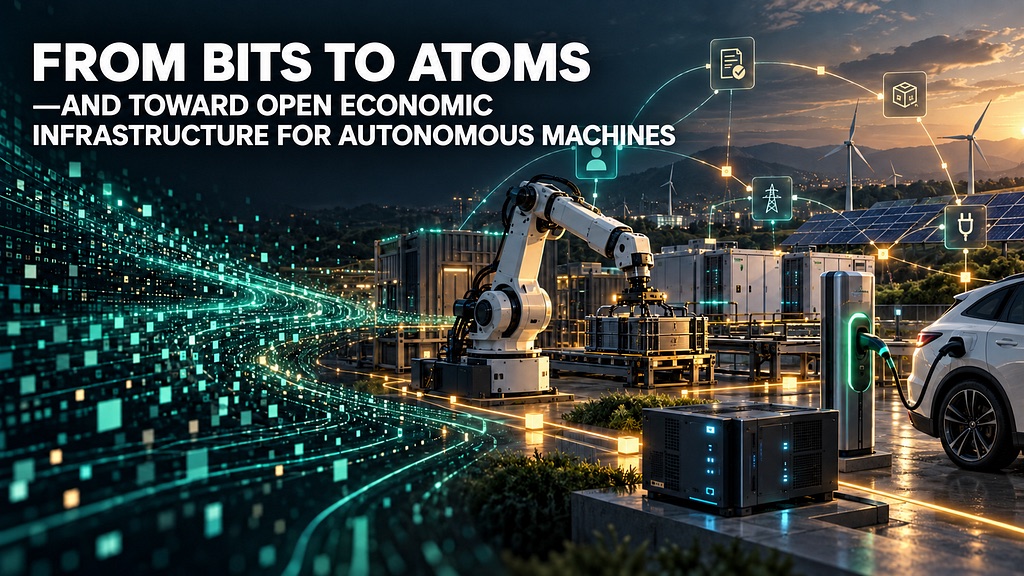
For most of the computing era, technology advanced by making information programmable.
Computers transformed bits. Storage preserved them. Networks moved them. Software organized them into products, markets and entirely new forms of coordination.
Now the frontier is shifting from bits to atoms.
AI is moving beyond screens and servers into robots, vehicles, energy systems, factories and other machines that act in the physical world. Travis Kalanick’s Atoms describes this transition as “Digitizing the Physical World”: treating atoms more like bits so that software can understand, predict and control physical systems. Andreessen Horowitz has framed the same shift as the rise of industrial AI — specialized machines that transform, move and store physical matter at scale. (Atoms Vision, a16z)
This is an important shift. But it is only the first half of the story.
Making the physical world programmable does not automatically make the physical economy programmable.
A robot may know how to navigate a warehouse, deliver a package or charge a vehicle. An energy device may know how to produce and distribute electricity. A machine may be able to sense, decide and act without human intervention.
But can it receive a job from a machine owned by someone else?
 Can it prove that the job was completed?
 Can it receive payment, pay for energy or compute, and settle revenue among multiple stakeholders?
 Can another business verify its operating record without trusting the machine manufacturer’s private database?
 Can a lender or insurer evaluate the machine based on what it has actually done?
Today, the answer is usually no.
Intelligence gives a machine the ability to act. Economic infrastructure gives it the ability to participate.
The next stage of the machine economy will therefore require more than capable robots. It will require an economic layer designed for machines.
Machines Are Ready to Work. The Economy Is Not Ready for Them.
Today’s autonomous machines are economically dependent even when they are physically autonomous.
Their identity usually exists as a record in a manufacturer’s cloud. Their permissions are managed by a proprietary platform. Their operating data sits in a private database. Payments are received through the bank account or wallet of the company operating them.
The machine itself has no portable economic interface connecting its identity, authority, work and transactions.
This architecture works when every machine belongs to one operator and every interaction takes place inside one platform. It breaks down when machines from different manufacturers, owners, networks and countries need to work together.
Consider a delivery robot that needs to purchase energy from an independently operated charging station.
The robot must know the price, authorize the purchase and remain within a spending limit set by its owner. The charging station must know that the robot can pay. Both sides need a reliable record of how much energy was delivered. Payment should settle according to the agreed conditions, and the resulting revenue may need to be divided among the station owner, operator and energy supplier.
If every step requires a human account, a proprietary API and a bilateral commercial integration, the interaction is not truly autonomous.
It is simply a conventional platform transaction with a robot at the edge.
The machine economy begins when machines can coordinate across organizational boundaries under transparent, programmable rules.
That does not mean making machines independent legal persons. Nor does it mean giving them unrestricted control over money.
It means giving machines controlled economic agency: the ability to act within permissions defined by their owners and operators, while making their actions verifiable to counterparties.
Every Autonomous Machine Will Need an Account
Every person and every company needs an account to participate in the economy. Autonomous machines will need one as well.
But a machine account is more than a crypto wallet.
A wallet manages a key, signs a transaction and holds assets. A machine account must represent a much richer set of relationships:
- What machine is this?
- Who owns it?
- Who operates it?
- What is it authorized to do?
- How much can it spend?
- What services can it provide or purchase?
- How is completed work measured?
- Where should revenue be routed?
- What operating and transaction history belongs to this machine or fleet?
A wallet lets a machine hold a key.
An account defines how a machine participates in the economy.
The account becomes the economic interface between the physical machine, its owner, its operator, its customers and the networks through which it transacts.
But an account alone is still not enough.
A machine economy requires three distinct flows to converge.
Three Flows, One Machine Economy
Every real-world machine business contains three flows.
The first is the business flow. This defines what the machine has been asked to do: the service, price, unit of work, permissions, conditions of delivery and criteria for completion.
The second is the information flow. This records what happened in the physical world: machine identity, sensor readings, operating data, signed events and proof that a service was delivered.
The third is the value flow. This covers payment, escrow, settlement, revenue routing and the distribution of value among the parties involved.
Today, these flows usually live in separate systems.
The business flow runs in an operator’s cloud platform. The information flow is stored in a device manufacturer’s database. The value flow runs through a bank, payment processor or blockchain wallet that has little connection to the machine’s actual work.
Because the three systems do not share a verifiable state, someone must reconcile them.
A platform must decide whether the machine completed the task. An operator must match device logs with customer payments. A financier must rely on reports produced by the same company seeking capital. Every new relationship requires another integration and another trusted intermediary.
This architecture does not scale to an economy in which millions of machines continuously transact with machines they have never encountered before.
The physical economy becomes programmable only when business flow, information flow and value flow converge in a shared, independently verifiable system.
Why This Convergence Must Be Onchain-Verifiable
Blockchain is not the computer that should control a machine.
Real-time navigation, motor control, video processing and high-frequency sensor decisions belong on the device, at the edge or in specialized cloud infrastructure. It would be inefficient and often impossible to put them onchain.
Blockchain serves a different role.
It provides a neutral coordination and settlement layer between machines and organizations that do not share the same platform or trust the same database.
Not every byte of machine data needs to live onchain. But every economically meaningful event should be onchain-verifiable.
Raw video, LiDAR and telemetry can remain on the device, at the edge or in private storage. The economically relevant evidence — device signatures, timestamps, hashes, Merkle roots, service receipts and critical state transitions — can be committed onchain.
Similarly, an entire business process does not need to run in a smart contract. But the terms that determine authorization, payment and settlement should be represented in a way that counterparties can verify.
The value flow can then use programmable assets such as stablecoins to settle according to the same conditions.
This creates a shared economic state:
- The machine was authorized to perform a specific action.
- Payment was committed under defined conditions.
- The machine produced a signed record of the work.
- The record was independently verified.
- Revenue was settled and routed according to agreed rules.
Machines do not need to trust one another.
They need a shared system in which economically meaningful actions can be verified.
That is what enables coordination across manufacturers, operators and jurisdictions without requiring one platform to own the entire transaction.
AI decides what the machine should do. Edge systems control how it does it. Blockchain verifies what happened and settles the resulting value.
A Payment Is Not Yet Machine Commerce
Much of today’s discussion about the agent economy focuses on wallets and payments.
This is understandable. A machine must be able to receive and send value. Stablecoins and programmable payment protocols make this increasingly possible.
But moving money is not the same as completing commerce.
A payment does not prove that a physical service was delivered. A wallet does not explain what the machine was authorized to do. A transaction hash does not establish that energy was supplied, a package was transported or a robot completed a task.
Machine commerce requires a closed loop:
Pay → Work → Proof → Settle
Pay initiates the value flow. A person, company, AI agent or another machine authorizes payment under defined conditions.
Work executes the business flow. The machine activates and delivers a measurable physical service.
Proof connects physical reality to the transaction. The machine or trusted hardware signs evidence of what was delivered, when and under what conditions.
Settle closes the loop. Once the required evidence is verified, value is distributed according to the commercial agreement.
Pay moves value.
 Work delivers the service.
 Proof connects reality to the transaction.
 Settlement closes the economic loop.
The atomic unit of the machine economy is therefore not a wallet or a payment. It is a verifiable commerce loop.
One Loop Is a Transaction. Thousands Become a Track Record.
A single completed loop records one sale.
Thousands of loops begin to describe an economic asset.
Over time, repeated machine activity can produce a verifiable history of:
- Utilization
- Throughput
- Services delivered
- Revenue generated
- Settlement performance
- Energy and operating costs
- Downtime
- Maintenance events
- Reliability
This does not turn a machine into an independent borrower. The machine remains owned and operated by people or organizations with legal rights and obligations.
What changes is the quality of evidence available to those organizations and their financial partners.
Instead of evaluating a machine only through invoices, spreadsheets and operator-generated reports, lenders and insurers can use authorized, machine-attributed operating and transaction records.
That can support better underwriting for equipment finance, fleet expansion, leasing, insurance and cash-flow financing.
Blockchain does not automatically create credit. It does not eliminate operational risk, ownership risk or the need for professional underwriting.
It makes economically relevant machine activity more visible and verifiable.
Machine finance begins when operating reality and financial reality become cryptographically connected.
One loop is a transaction. Thousands become a track record. A track record can become the basis for financial access.
The Machine Economy Cannot Be Built Behind One Platform’s API
The machine economy will span different chips, devices, manufacturers, operators, blockchains, payment networks and jurisdictions.
No single company will control the entire stack.
If machine identity, permissions and operating history exist only inside one cloud platform, machines remain economically trapped even if they are technically autonomous.
Open machine commerce therefore requires open infrastructure.
The device-level runtime should be open, hardware-neutral and chain-neutral. Machine records should be portable. Economic events should be independently verifiable. Owners and operators should control access to sensitive data.
This is also why the foundational products should be free to embed and open source.
The objective is not to charge every manufacturer for a software licence before its first machine can participate. The objective is to make a common economic interface available across as many machines and physical industries as possible.
The infrastructure should be open. The network can grow with the economic activity it enables.
This produces a different business model from traditional enterprise software:
Open-source the economic infrastructure. Monetize the financial flow.
The economic layer becomes the distribution mechanism. Payments, managed settlement, enterprise services, insurance and financing become the commercial network around it.
Building the Economic Infrastructure for Autonomous Machines
This is the infrastructure TLAY is building.
TLAY consists of two open-source core products and a configurable solution framework that turns them into working machine businesses.
BoAT: The Economic Runtime Inside the Machine
BoAT is a lightweight runtime that embeds cryptographic and economic capabilities directly into robots, energy devices and other connected machines.
It provides:
- Device-bound identity and keys
- Owner-defined permissions
- Signed operating data
- Proof-of-service generation
- Payment authorization
- Smart-contract interaction
BoAT does not give a machine unrestricted autonomy. It gives the machine controlled economic authority.
The owner defines the rules. The machine executes within them. Counterparties can verify the resulting signatures.
BoAT makes the physical machine economically addressable and programmable.
HashAnchor: Verifiable Economic Records Across the Network
BoAT signs machine activity at the source. HashAnchor makes that activity independently verifiable across organizations.
HashAnchor verifies device signatures, links machine events to business and payment events, batches records into Merkle roots, anchors them onchain and issues portable receipts.
Its purpose is not to claim that cryptography alone guarantees physical truth. Its purpose is to make provenance, integrity and the declared trust level of each record independently checkable.
HashAnchor turns machine activity into verifiable economic records.
Machine Commerce Enabler: From Machine Capability to a Working Business
BoAT and HashAnchor provide the infrastructure primitives. Machine Commerce Enabler turns those primitives into a deployable business loop.
It is a configurable solution framework that defines:
- What service the machine provides
- How the service is measured
- How it is priced
- What payment activates it
- How the machine is controlled
- What evidence proves delivery
- How revenue is settled and distributed
This makes it possible to adapt the same core infrastructure across energy, charging, robotics, compute and commercial IoT without building an entirely new system for every deployment.
BoAT enables the machine. HashAnchor verifies the activity. Machine Commerce Enabler orchestrates the business, information and value flows into a working Pay → Work → Proof → Settle loop.
From Individual Machines to an Open Economic Network
The long-term value of this infrastructure is not limited to any single machine or payment.
As more manufacturers embed machine accounts, more machines can participate in commerce.
As more machines generate verifiable operating and transaction histories, payment providers, insurers and capital providers gain better visibility into machine activity.
As more services and financing options become available, integrating the economic infrastructure becomes more valuable to the next manufacturer and operator.
The network compounds:
More machines → more verifiable activity → better economic records → more services and capital → better economics for machine operators → more machines
This is the foundation of a multi-sided machine economy.
On one side are manufacturers, fleet operators, asset owners and Physical AI developers.
On the other are customers, service providers, stablecoin networks, payment companies, insurers and capital providers.
Between them is a shared economic layer connecting identity, authority, work, proof and value.
The relevant measure is not simply how many devices have downloaded an SDK or created a wallet.
It is how many machines are closing commerce loops, generating verifiable work and building persistent economic histories.
The Machine Economy Will Begin Where Work Is Measurable
The earliest machine economies will emerge where physical work has a clear unit, can be independently measured and produces recurring revenue.
An energy device can sell electricity by the kilowatt-hour.
 A charging station can sell power by energy delivered or time connected.
 A robot can charge per task, delivery, kilometre or minute of operation.
 A compute machine can receive payment per job.
 A commercial device can charge per litre, cycle or unit of service.
In each case, the structure is the same:
A service is priced.
 A payment is authorized.
 A machine performs the work.
 Delivery is proven.
 Revenue is settled.
TLAY’s eCandle implementation demonstrates this loop with physical energy infrastructure. Payment activates an energy device, the device delivers measurable power, BoAT signs the service record, HashAnchor makes the record independently verifiable, and revenue can be settled among the participating stakeholders.
Energy is one starting point. The same economic architecture can extend to robotics, charging, autonomous compute and other productive machines.
The form of the machine changes. The commerce loop remains.
From Bits to Atoms — and From Atoms to an Economy
The first computing revolution made information programmable.
The next is making the physical world programmable.
Sensors make physical conditions legible to software. AI predicts what will happen. Robots and automated machines change the state of the physical world.
But a world of programmable machines still needs a programmable economy.
Machines need accounts that connect identity with authority. Physical work needs to become digitally provable. Business, information and value flows need to converge in a shared, onchain-verifiable system. Payments need to settle according to what actually happened in the physical world.
Only then can machines owned by different parties coordinate at scale without requiring one company to control the entire system.
Every autonomous machine will need an account. Every economically meaningful machine event will need a verifiable record. And an open machine economy will need infrastructure that no single platform owns.
Physical AI is making atoms programmable. TLAY is making their economy programmable.