Money has gone digital. Many people already get paid, receive remittances and save in stablecoins. The machines on the street haven't caught up. A solar charger, a water dispenser or a laundry machine still wants coins, a card terminal, or someone to come and switch it on.
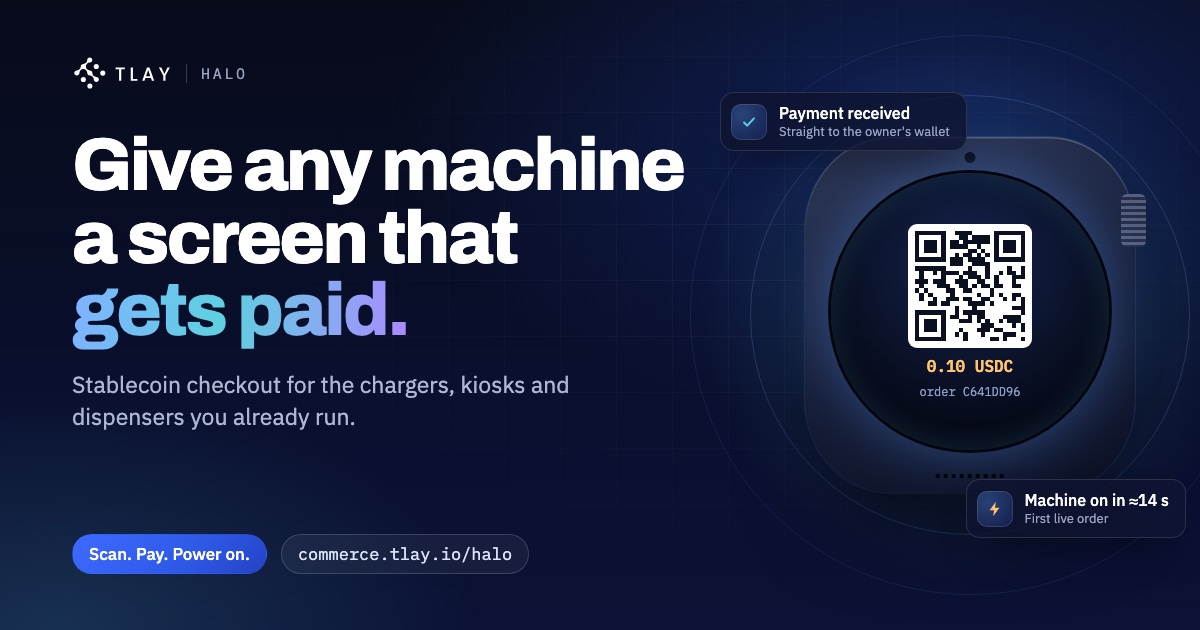
Today we're introducing Halo, a palm-sized round screen that lets the machines you already run get paid in stablecoin. Halo mounts beside the machine. It greets customers, quotes the price, shows a one-time payment code, and switches the machine on once the stablecoin lands in the owner's wallet.
No new machine. No card terminal. No merchant account.
Why existing machines
Behind every charger, washer, battery cabinet and self-service kiosk, someone has already paid to build it, site it, install it, maintain it and market it. The machines work, and there is real demand around them. What's missing is a way for a stablecoin wallet to buy from them.
That is why we start with the installed base instead of new hardware. A lightweight retrofit adds a stablecoin storefront and automatic switching to supply and demand that already exist. Operators keep the sites and machines they have, and every new buyer becomes new revenue.
The device
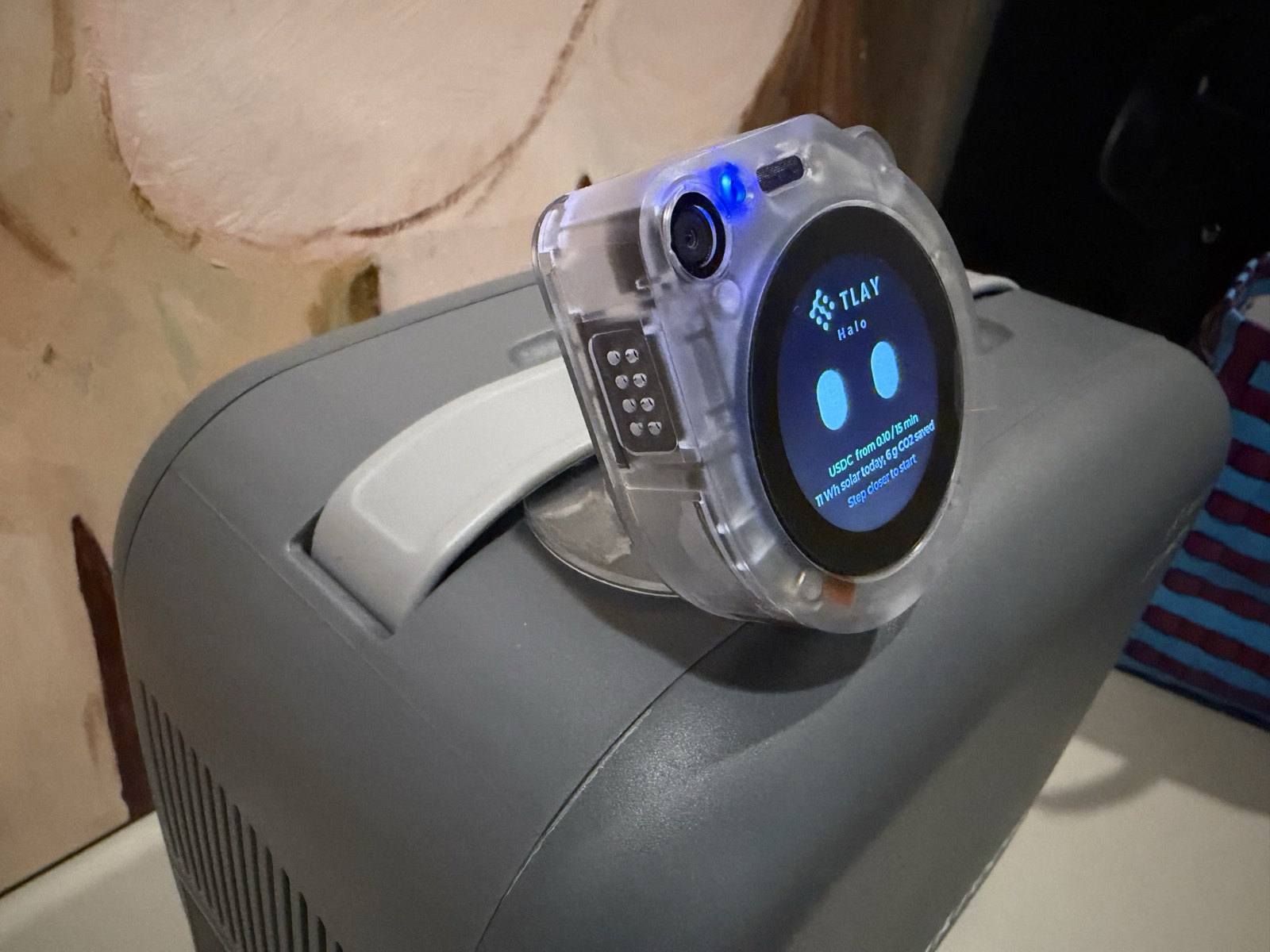
Halo is palm-sized, powered by 5 V and connected over Wi-Fi. It combines payments and on-site guidance in one device:
- A 412 × 412 round display shows a fresh payment code for every order, with the amount, the order code and a countdown.
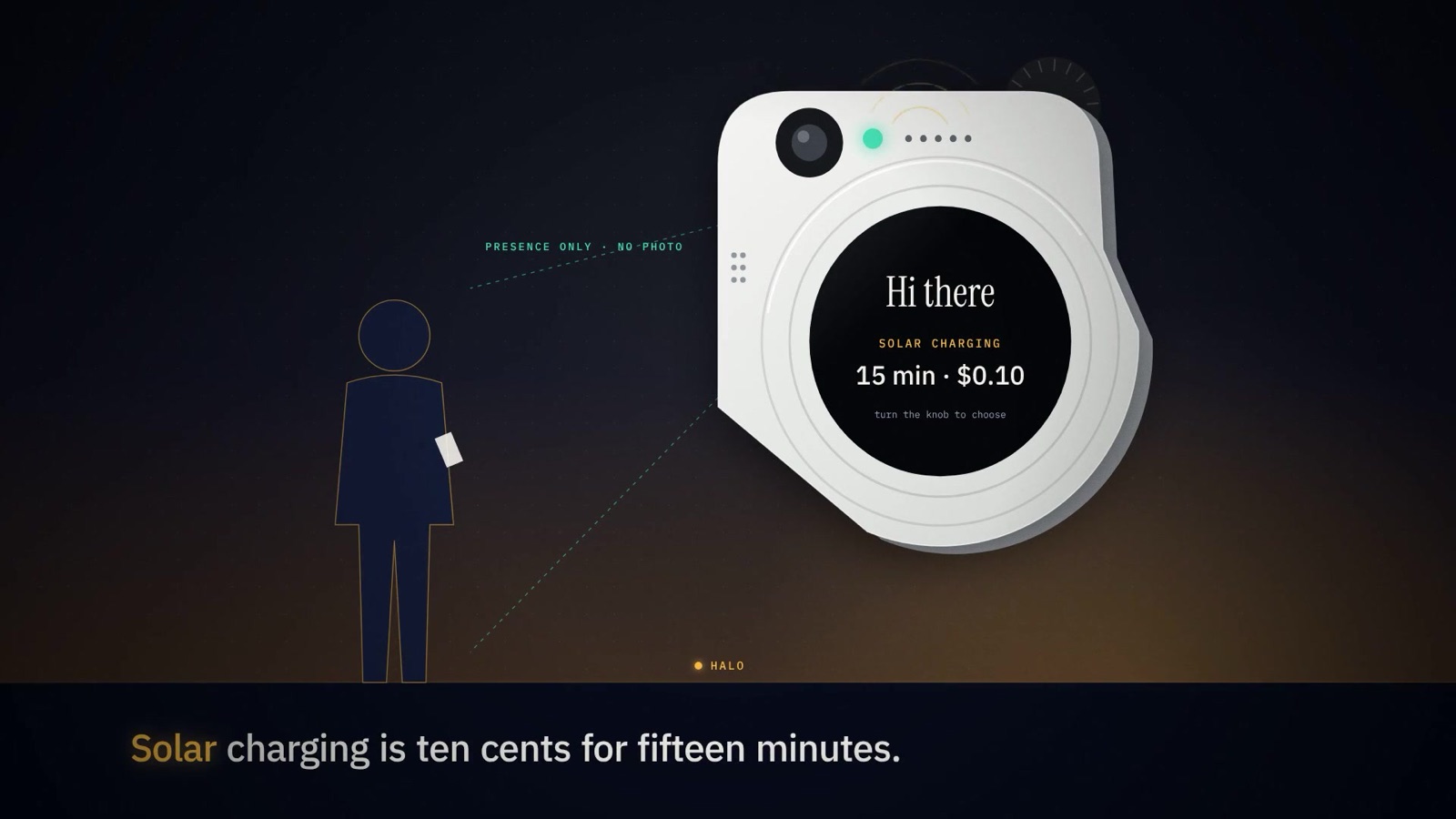
- On-device eyes. The vision chip only decides "someone here" or "no one", to wake the screen and greet people. It takes no photos and uploads nothing.
- A knob to choose and order. There's no touchscreen, so it works with gloves on.
- A speaker and mic. Halo quotes prices, announces payments, and answers common questions like "how long is left?" offline.
| Spec | Detail |
|---|---|
| Display | 412 × 412 round |
| Processor | ESP32-S3 |
| Vision | Himax WE2, on device |
| Connectivity | Wi-Fi, BLE |
| Power | 5 V, 1 A |
| Payments | Stablecoin, one QR code per order |
For customers: walk up, scan, it's on
Customers don't need to understand crypto. Halo tells them what to do at every step, on screen and out loud.
- Walk up. Halo notices someone and greets them with the price.
- Pick a plan. Turn the knob to choose, press to order.
- Scan and pay. A fresh code for each order, with the amount already filled in.
- Paid. The payment confirms on-chain. Halo shows it and says it.
- Running. The machine powers on, with a countdown on Halo's screen.
There is no app to install, no cash or change, and because every order has its own code, there's no fake sticker to swap over a real one.
Money takes one path, signals take another
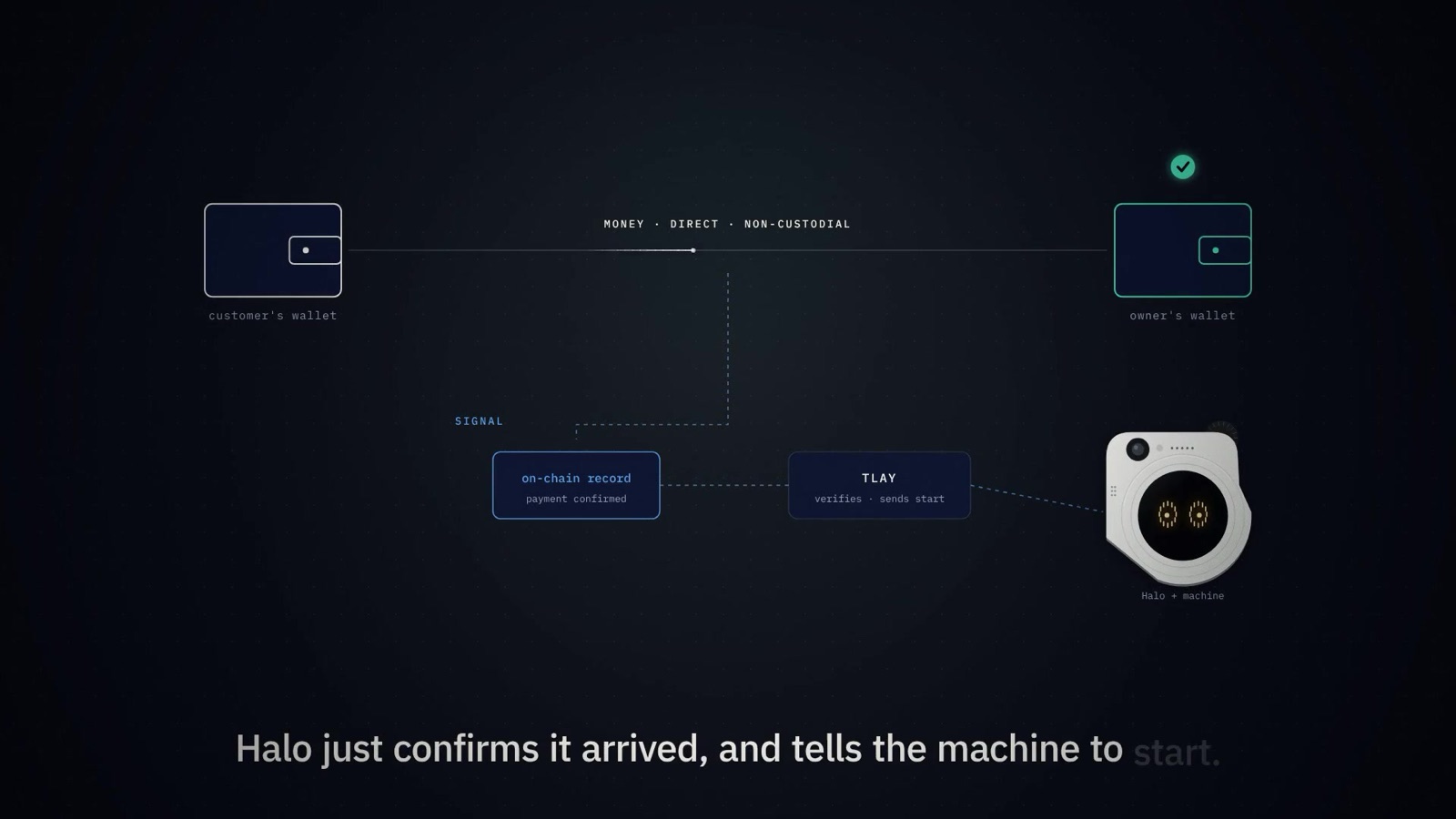
The customer's stablecoin goes straight to the machine owner's wallet. TLAY only sees that the payment has confirmed and sends the start command.
- We never hold the money. It's non-custodial: stablecoin moves from the customer's wallet to the owner's, with no pooled balance in between.
- Seconds, not days. A payment is final once it confirms on-chain. There are no chargebacks and no settlement cycle.
- Every order on record. Each payment is on-chain, so owners can see exactly what every machine earns.
For owners
| Cash and coins | Card terminal | Halo | |
|---|---|---|---|
| Replace the machine? | No | Add a reader, often with rework | No, it mounts alongside |
| Merchant bank account? | Not needed | Required | Not needed |
| Who collects and reconciles? | Someone has to visit | Automatic | Automatic, every order on-chain |
| Time to funds | When the cash is collected | Usually next day or later | Seconds |
| Chargebacks and leakage | Lost or under-reported | Chargebacks | Final transfers |
| On-site guidance | Depends on staff | None | Screen and voice |
| What the customer needs | Coins | A bank card | A wallet holding stablecoin |
The last row is Halo's real hurdle, and we'd rather say so: today, the customer needs a wallet with stablecoin in it. That is also the opportunity. People who hold stablecoins and carry no coins can now pay.
Plugs into the machine you have. If the operator platform can already switch the machine, Halo uses that API. Machines with no platform will get an I/O board on their power switch or coin slot. Our target for setup is about ten minutes from box to live site: mount, connect to Wi-Fi, scan a setup code that pairs Halo with the machine and the owner's wallet, and run a test order. Setup-code pairing is still in development.
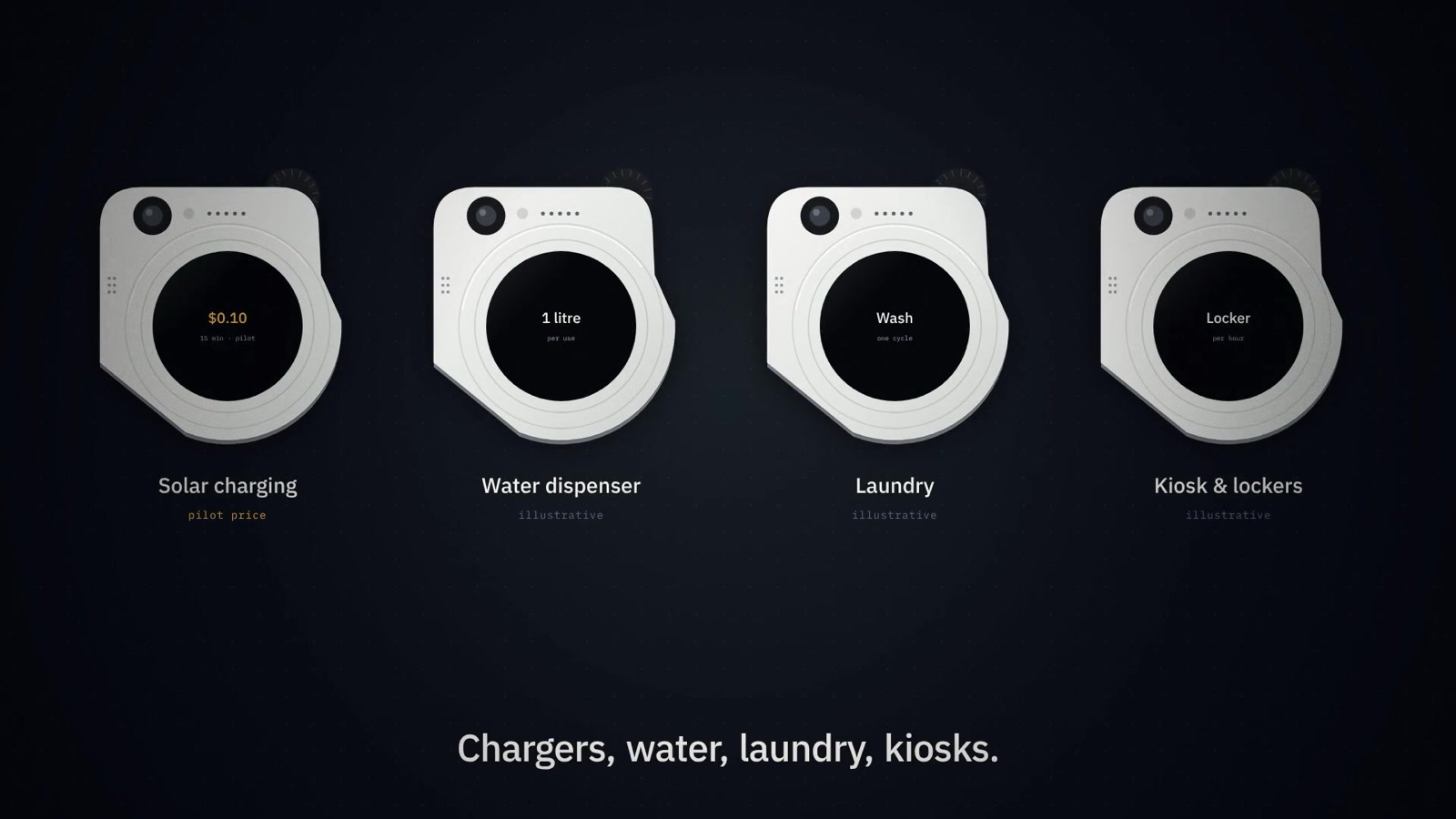
Halo is built for machines that sell by the use or by the minute: small tickets, frequent use, unattended, and switchable remotely. Solar charging, water dispensers, laundry, kiosks and lockers all fit.
The Halo family
| Product | What it is | Status |
|---|---|---|
| Halo Tag | QR code plus NFC sticker, under $1, for spots that need no on-site guidance | Planned |
| Halo | The talking round terminal for unattended machines | Pilot device |
| Halo + I/O | Adds a relay and coin-pulse board to drive offline legacy machines | Planned |
| Halo Inside | A module built into new machines | Later |
Already running on real hardware
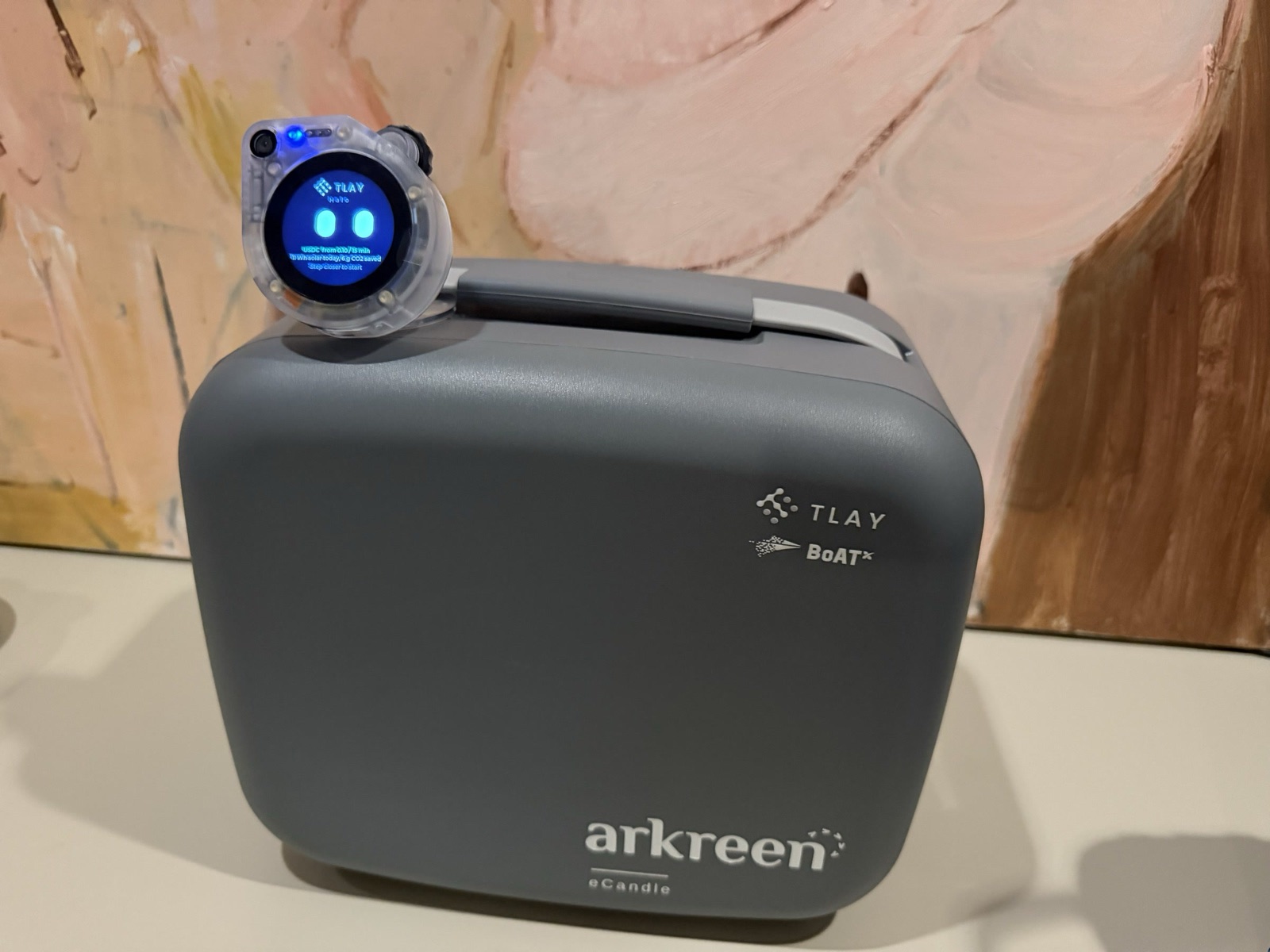
On 17 November 2026, Halo took its first live order on an eCandle solar charging station: 15 minutes of charging for $0.10, paid in stablecoin. About 14 seconds passed from Halo seeing "paid" to the station powering on. Next, we bring that down and track it at every pilot site.
Where this goes: Machine Commerce
Halo is where TLAY Machine Commerce starts. Machine Commerce is a network of real-world machine services for the stablecoin economy. It connects three things that already exist: stablecoins and wallets that carry the money, operators who hold the real-world supply, and software that turns a purchase into an order a machine can carry out.
Every order is described the same way (what is sold, for how much, who gets paid, and which machine runs it), so wallets and machine platforms integrate once and reuse it. Each machine added gives wallet users more to buy, and each wallet added brings operators more customers.
Today, people scan and pay. Next, we open interfaces for location, availability, price, ordering and fulfilment, so AI agents acting with permission can find and buy machine services too. A delivery robot could find a compatible charger along its route, buy a charge within its budget, and carry on.
Read the full thesis at commerce.tlay.io/halo/thesis.
Common questions
Does the money pass through TLAY? No. Stablecoin moves straight from the customer's wallet to the machine owner's wallet. The platform only reads the on-chain payment and sends the start command.
Does the camera record customers? No. The vision chip decides on the device whether someone is there, only to wake the screen and greet them. No photos are taken or uploaded.
What if the connection is poor? Halo needs Wi-Fi to show payment codes and confirm payments. Simple voice questions, like how much time is left or how to pay, work offline.
Which countries can use Halo? Stablecoin rules differ by country and change quickly. We go market by market: a local legal opinion first, then the size of the pilot.
Join the pilot
We're running Halo at 10 to 20 pilot sites.
We provide: Halo terminals and installation guidance; plans, prices and voice prompts set up for your machine; a local compliance check, done with you; and a pilot readout covering first-scan success, seconds from payment to power, and repeat use.
You bring: a pay-per-use or pay-per-time machine that can be switched remotely or wired to a relay; Wi-Fi and 5 V power on site; and a wallet that can receive stablecoin.
Tell us what your machines sell and where they are, and we'll come back with how Halo would fit: [email protected] · commerce.tlay.io/halo
Tomorrow we'll publish a one-take demo of Halo on a live charger, from "Hi Halo" to power on.