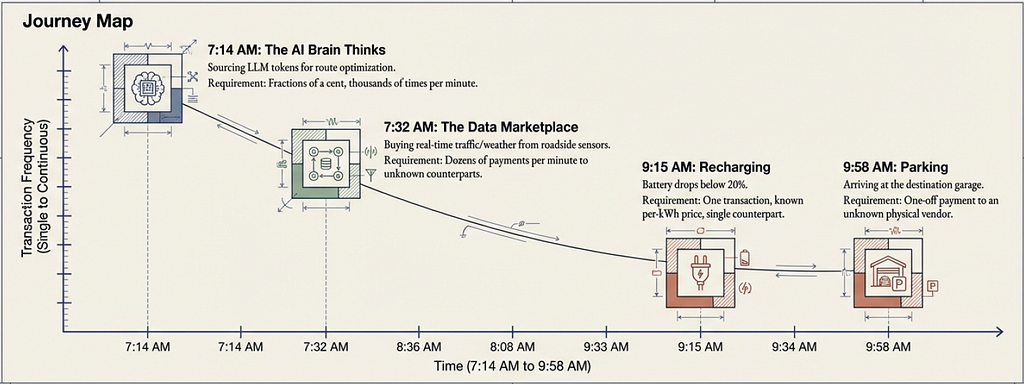
It’s 7:14 AM. An autonomous electric vehicle in Los Angeles powers on its onboard AI. Before it moves an inch, it’s already spending money.
The AI consults a large language model to analyze the day’s delivery schedule, optimize the route, and reason about weather conditions. Tokens stream in, and the vehicle pays for each one — fractions of a cent, thousands of times per minute. There’s no invoice. No billing cycle. Just a continuous flow of value for a continuous flow of intelligence.
At 7:32, the vehicle pulls onto the expressway. It begins purchasing real-time traffic density data from roadside sensors, accident reports from a municipal feed, and live weather updates from a commercial provider — three different data sellers, none of whom the vehicle has ever transacted with before. Each query costs a fraction of a cent. Dozens of payments fire every minute, to dozens of different counterparts.
At 9:15, the battery indicator drops below 20%. The AI selects a charging station two kilometers ahead, negotiates a per-kWh rate, and authorizes a single payment. One station, one transaction, a known price.
At 9:58, the vehicle parks at its destination and pays the garage. Another single payment to another merchant it may never visit again.
Four different payment patterns. Four different relationships between payer and payee. Four different sets of constraints on latency, trust, and cost.
No single payment protocol handles all of them well. And that’s the challenge — and opportunity — at the heart of the machine economy.
The Problem: Human Payment Rails Don’t Fit Machines
Every payment system we use today was designed for humans. Credit cards require cardholder agreements. Bank transfers require account setup. Even modern fintech — Apple Pay, Stripe Checkout, PayPal — assumes a person is present to approve, authenticate, or at minimum click a button.
Machines can’t do any of this. An autonomous vehicle can’t fill out a registration form at a charging station. A warehouse robot can’t set up a billing account with every parts supplier. An AI agent can’t navigate a checkout page to buy compute time.
As AI agents and autonomous machines become economic actors — buying APIs, paying for compute, purchasing physical services — they need payment infrastructure that is:
- Programmatic: Negotiated and settled entirely in code, within standard internet protocols
- Instant: No batch processing, no T+2 settlement, no “pending” states
- Granular: Capable of sub-cent transactions without prohibitive overhead
- Permissionless: A machine should be able to pay a counterpart it has never encountered before, with no prior account setup
In March 2026, three distinct approaches emerged to solve this problem — each from a major player, each making different architectural trade-offs.
Three Protocols, Three Philosophies
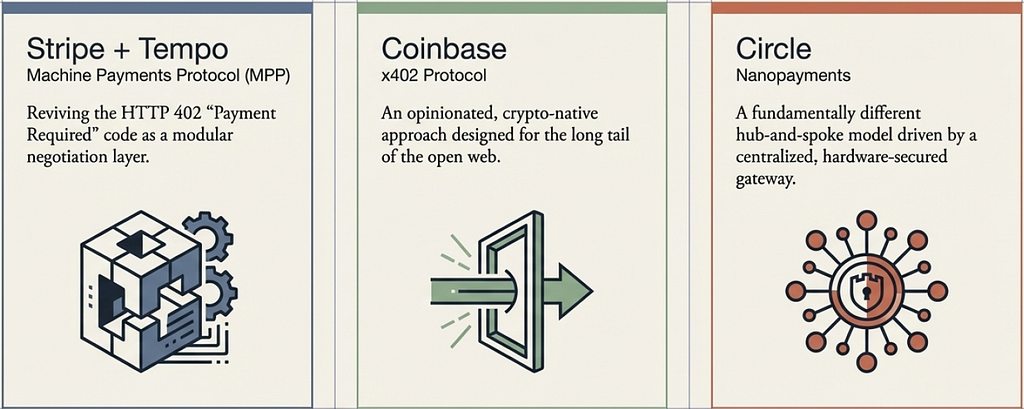
Stripe + Tempo: The Machine Payments Protocol (MPP)
MPP, co-authored by Stripe and Tempo, revives the long-dormant HTTP 402 “Payment Required” status code as a structured payment negotiation layer. When a machine requests a paid resource, the server responds with a 402 challenge describing the price and acceptable payment methods. The machine pays and retries the request with a payment credential. The server verifies and delivers the resource.
What makes MPP distinctive is its modularity. It separates what to pay (intents like “charge” or “session”) from how to pay (methods like Tempo blockchain, Stripe card networks, Lightning, or Solana). Any payment network can plug in by implementing a method spec. And it works with both crypto and fiat — a rare property in this space.
MPP offers two intents:
- Charge: A one-off payment for a single request. Simple, direct, no ongoing relationship required.
- Session: A payment channel where the machine deposits funds upfront, then streams micropayments as it consumes a service — thousands of tiny transactions aggregating into periodic settlements. Tempo calls this “OAuth for money.”
Coinbase: The x402 Protocol
Coinbase’s x402 also uses HTTP 402, but takes a simpler, more opinionated path. It’s crypto-native (USDC on EVM chains and Solana), uses a single request-pay-return flow, and relies on a Facilitator service (currently Coinbase’s own infrastructure) to verify and settle payments.
x402 is designed for the long tail of the open web — any developer can put a paywall on any endpoint with minimal setup. It doesn’t have sessions or fiat support, but its simplicity is its strength. For straightforward “pay once, get the resource” interactions, x402 has the lowest barrier to entry.
Circle: Nanopayments
Circle, the issuer of USDC, announced Nanopayments in March 2026. It takes a fundamentally different architectural approach.
Instead of bilateral payment channels between each payer and payee, Circle operates a central gateway — a trusted intermediary running inside a hardware-secured enclave. A machine deposits USDC once into a gateway wallet. After that, every payment is just an off-chain signature — no gas, no on-chain transaction, no channel setup. Circle’s gateway validates the signature, confirms the payment to the merchant instantly, and periodically batches thousands of these micro-authorizations into a single on-chain settlement.
The minimum payment? One millionth of a dollar. The trust model? You trust Circle’s hardware enclave — not a decentralized consensus mechanism, but a commercially secured processing environment.
The Topology Insight: Depth vs. Breadth
These protocols aren’t just different implementations of the same idea. They reflect fundamentally different assumptions about the shape of machine-to-machine commerce.
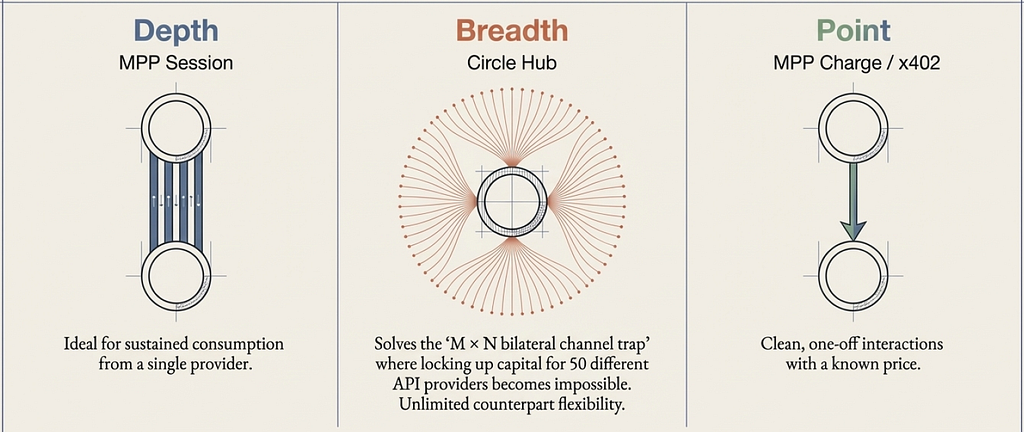
MPP Sessions: Optimized for Depth
An MPP session creates a dedicated payment channel between one payer and one payee. The machine deposits funds into an escrow, then streams micropayments through signed vouchers — each voucher authorizing a slightly higher cumulative amount. Settlement happens periodically, batching thousands of micro-transactions into a single on-chain operation.
This is elegant for a machine that consumes heavily from a single provider over time: an AI agent streaming millions of tokens from its primary LLM, or a robot consuming a continuous sensor feed from one data vendor.
But what happens when a machine needs to interact with many different providers?
Each new payee requires a new channel — a new on-chain deposit, new escrow state, new settlement lifecycle. An autonomous vehicle visiting 20 charging stations in a month needs 20 separate channels, each locking up capital. A delivery robot buying from 50 different API providers needs 50 escrows. If you have M machines and N service providers, you face up to M × N bilateral channels, each with its own capital lockup.
Circle Nanopayments: Optimized for Breadth
Circle’s hub model sidesteps this entirely. One deposit. Any merchant. No per-payee setup.
The tradeoff is clear: you gain unlimited counterpart flexibility at the cost of routing all payments through a centralized intermediary. Circle secures this with hardware enclaves and provides a trustless on-chain withdrawal as a fallback, but it’s architecturally a hub-and-spoke system — not a peer-to-peer one.
Neither Alone Is Sufficient
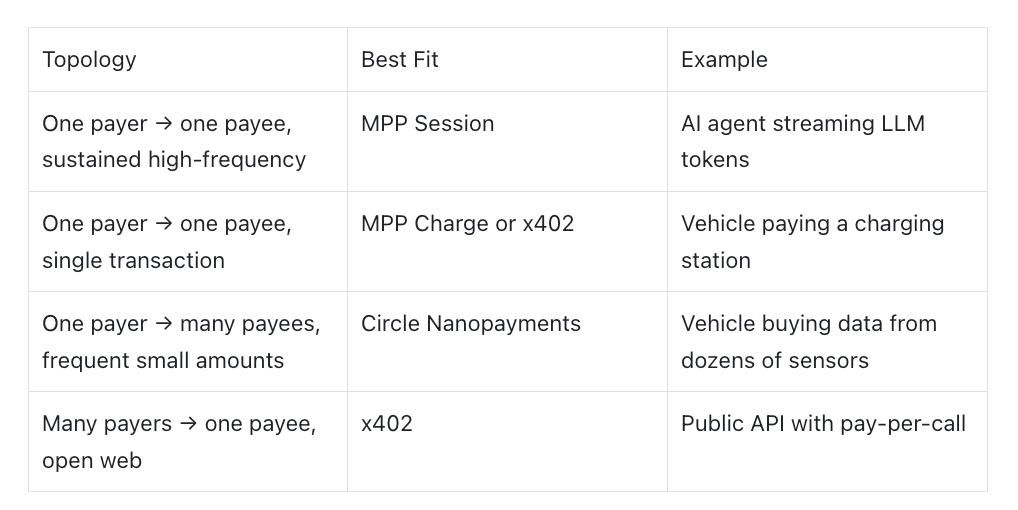
This isn’t a competition where one protocol wins. It’s a recognition that the machine economy has multiple payment topologies, and different protocols fit different shapes:
A Smart Car’s Payment Stack
Let’s return to our autonomous vehicle and map its day to a payment architecture.
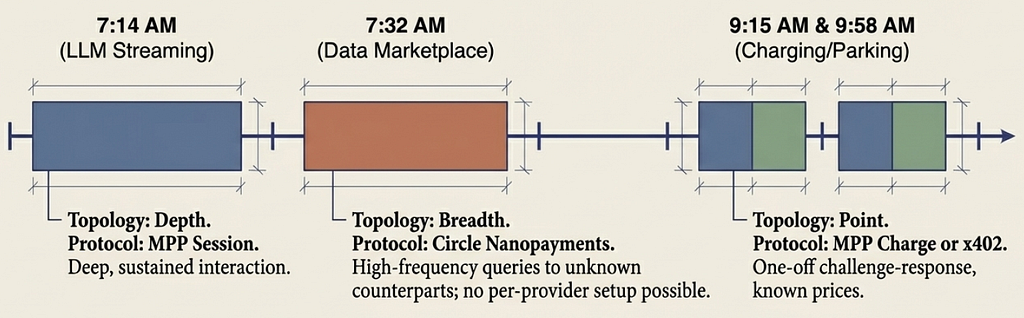
7:14 AM — The AI Brain Thinks
The vehicle’s onboard AI opens a session with its LLM provider. It deposits funds into an escrow and begins streaming requests. As each response streams back token by token, the vehicle signs vouchers authorizing increasing cumulative payments. If the AI’s reasoning runs long and the balance drops to zero mid-response, the LLM pauses, the vehicle signs a higher voucher, and streaming resumes. No round-trip to a blockchain. No interruption in the conversation.
Protocol: MPP Session — Depth pattern. One provider, sustained consumption, variable cost that’s metered in real time.
7:32 AM — The Data Marketplace
On the expressway, the vehicle needs real-time information from multiple independent sources: traffic sensors from Company A, weather data from Service B, road condition reports from Provider C. These are small, frequent queries — maybe a fraction of a cent each — to counterparts the vehicle has never transacted with before and may never transact with again.
Setting up a separate payment channel with each provider is impractical. Instead, the vehicle has pre-deposited USDC in a gateway wallet. Each data query is paid with a simple off-chain signature. The gateway confirms instantly. The vehicle gets its data without ever touching a blockchain.
Protocol: Circle Nanopayments — Breadth pattern. Many providers, micro-payments, no per-provider setup.
9:15 AM — Recharging
The vehicle pulls into a charging station. The price is known: a per-kWh rate, publicly advertised. The vehicle requests the charging service, receives a payment challenge, authorizes a single payment for the estimated charge amount, and plugs in.
No session needed. No streaming. Just a clean, one-off transaction.
Protocol: MPP Charge — Point pattern. One provider, one payment, known price. The vehicle could also use x402 here — the flow is similar, and if the station accepts USDC on Base or Solana, x402’s simplicity is appealing.
9:58 AM — Parking
The vehicle enters a parking garage. Similar to charging: a known hourly rate, a single counterpart, a straightforward payment. One challenge, one authorization, one receipt.
Protocol: MPP Charge or x402 — Same point pattern.
The Composite Picture
In a single morning, one vehicle used:
- A bilateral payment channel for deep, sustained interaction with its AI provider
- A hub-mediated micropayment system for broad, lightweight queries across many data sellers
- One-off challenge-response payments for physical services with known prices
No single protocol covered all three needs. The vehicle’s payment system is not a single rail — it’s a stack.
What’s Missing
The protocols exist. The building blocks are on the table. But the machine economy isn’t fully wired yet.
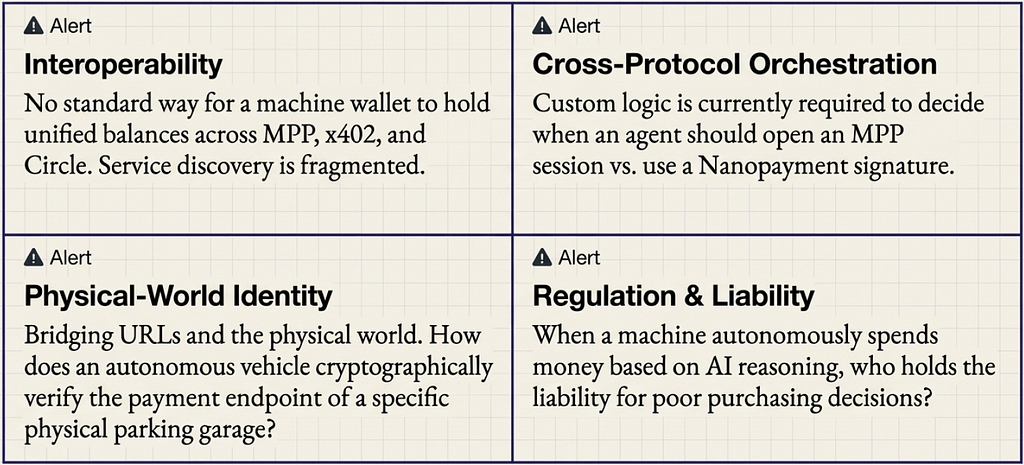
Interoperability: Today, MPP, x402, and Circle Nanopayments are independent systems. There’s no standard way for a machine’s wallet to hold balances across all three, or for a service provider to advertise which protocols it accepts in a unified way. A vehicle’s payment agent needs to know: does this station speak MPP, x402, or Nanopayments?
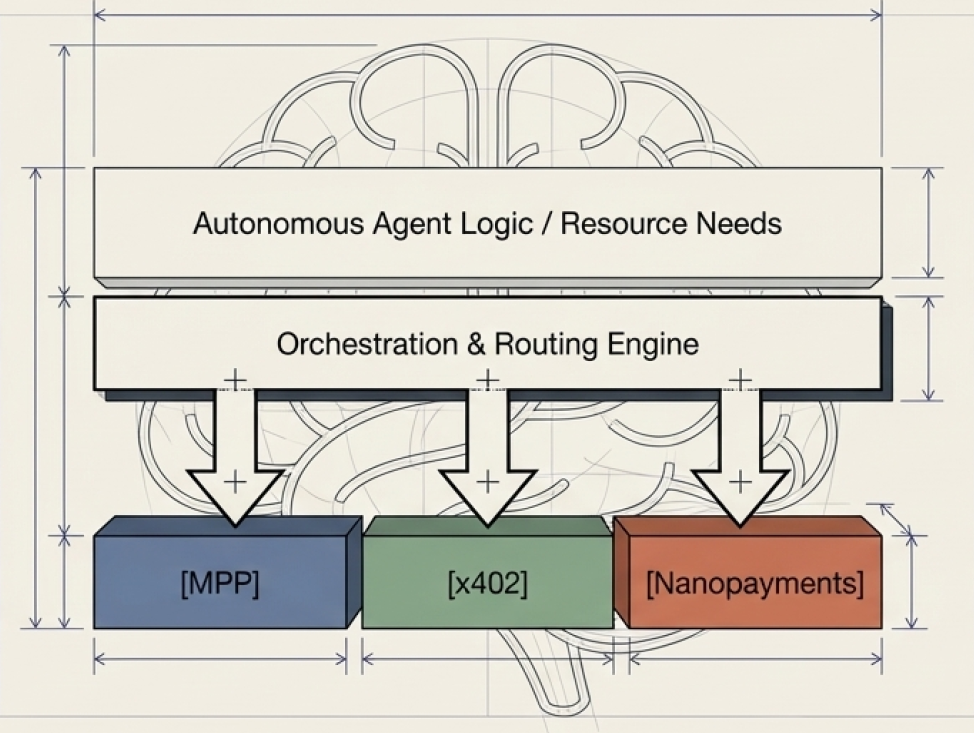
Cross-protocol orchestration: Who manages the vehicle’s payment strategy? When should it open an MPP session vs. use Nanopayments? Today, this logic would need to be custom-built. Tomorrow, it might be a standard “payment agent” layer that sits above individual protocols.
Stripe’s dual-protocol bet: Stripe supports both MPP and x402 as parallel integration paths under its “Machine Payments” product. This hedging strategy suggests even Stripe — the largest payment processor in the world — isn’t sure which topology will dominate. Or perhaps it has concluded that both will coexist.
Physical-world identity: Digital API payments are relatively straightforward — the machine knows the URL and can discover payment requirements. But how does an autonomous vehicle discover the payment endpoint of a physical charging station? How does a robot know the parking garage’s payment address? The gap between physical-world service discovery and digital payment protocols remains largely unaddressed.
Regulation: When a machine autonomously spends money, who is liable? Who holds the payment license? If a vehicle’s AI makes a bad purchasing decision, is it a consumer protection issue? These questions have no answers yet in most jurisdictions.
The Future Is a Payment Stack, Not a Single Rail
The human economy settled on a few dominant payment methods — cards, bank transfers, digital wallets — because human behavior is relatively uniform. We all walk into stores, visit websites, and pay bills in broadly similar ways.
The machine economy will be different. A robot on a factory floor has fundamentally different payment needs than an AI agent on the internet, which has fundamentally different needs than an autonomous vehicle on a highway. The interactions vary in frequency, counterpart diversity, latency tolerance, value per transaction, and trust model.
The protocols emerging in 2026 — MPP, x402, and Circle Nanopayments — aren’t competing for the same slot. They’re filling different positions in a stack:
- MPP Sessions for deep, sustained, streaming relationships where trust is established once and micropayments flow continuously
- MPP Charge and x402 for clean, one-off transactions with known prices and single counterparts
- Circle Nanopayments for broad, high-frequency micro-transactions across many counterparts from a single balance
The smart machine of the near future won’t choose one protocol. It will carry a payment stack — just as today’s smartphone carries credit cards, digital wallets, and cash equivalents, switching between them based on context.
The race isn’t to build the one payment protocol for machines. It’s to build the orchestration layer that lets machines use the right protocol for each moment.
The research behind this article is based on official protocol specifications, SDKs, and documentation from Stripe, Tempo, Coinbase, and Circle, as of March 2026.