
Picture two people at the end of a workday. One runs a shop with a robot arm that has an hour free. The other is a developer across town who needs one test run before morning. The machine is ready. The customer is ready. What would let them do business tonight?
Today we’re opening the public demo to show what that exchange can look like. You can take the buyer’s side, run a metered actuator service with test funds and inspect the receipt.
Why does the hour go unsold?
For a large job, it makes sense to call a shop, ask for a quote, open an account and reconcile an invoice. For a run that lasts less than a second, the phone call alone can cost more time than the job is worth.
Suppose the two people already know each other and agree on a rate. The buyer can send money from a wallet. But a wallet can’t tell either of them how long the motor ran. They still need a measurement they can both inspect and an agreement about what happens if the machine stops early.
What can a machine put up for sale?
An owner starts by listing a specific service. An actuator operator can offer up to a second of motion at a price per millisecond. A lab might instead offer an hour on an instrument, with a limit on the number of runs. A regular customer can buy prepaid periods and cancel future ones. The operator chooses the unit that makes sense for the work.
That listing gives different buyers the same terms to work with. A person can find the service in TLAY Market and sign with a wallet. Software can order through the API. An AI agent can use MCP to look for an available machine and request a run within a spending limit its payer signed. An agent ordering one run sees the same price per millisecond as a person at the bench.
How does one order turn into a payment?
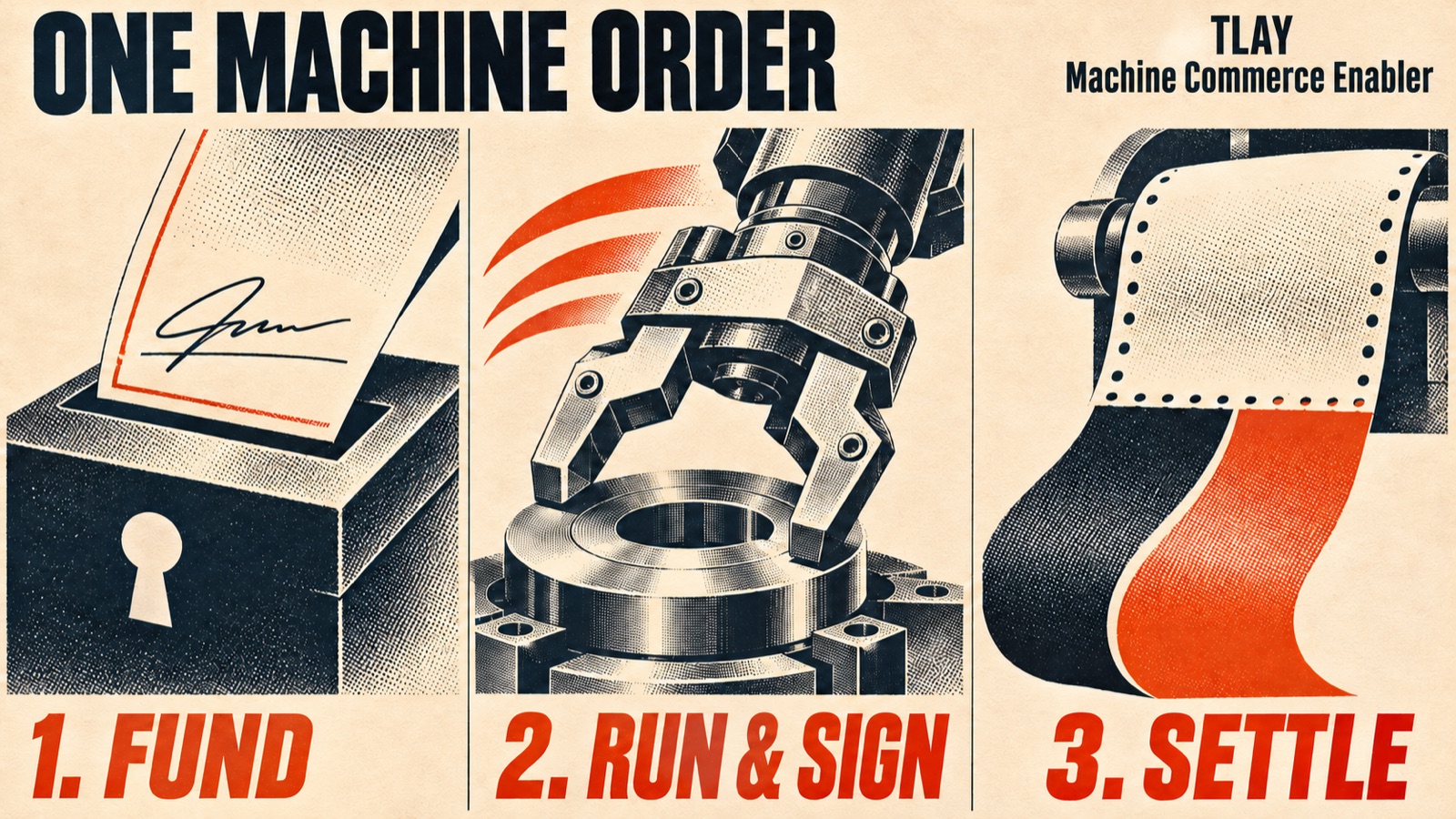
Follow the metered example on the launch page. The buyer authorizes a maximum of 0.01 test USDC for 1,000 milliseconds. A contract holds the funds. The actuator runs, measures 618 milliseconds and signs that record. The buyer can check the signature in their browser.
At the listed rate of 0.00001 test USDC per millisecond, 0.00618 goes to the seller and 0.00382 returns to the buyer when the order settles. No one has to write a second invoice for the shorter run.
The signature answers a precise question: which device reported this measurement? Whether the work was acceptable is a separate question. A service can name a dispute resolver in its terms. If the resolver misses the decision deadline, the buyer gets a full refund.
Try a first order in the 10-minute guide. The public demo uses a throwaway wallet and test funds, needs no installation and resets nightly. Production hardware is the next step.
If you make devices or operate a fleet, we’d like to hear about one job you could list. What would the customer buy, and what would the device measure to show it had done the work? Bring that example to early access.