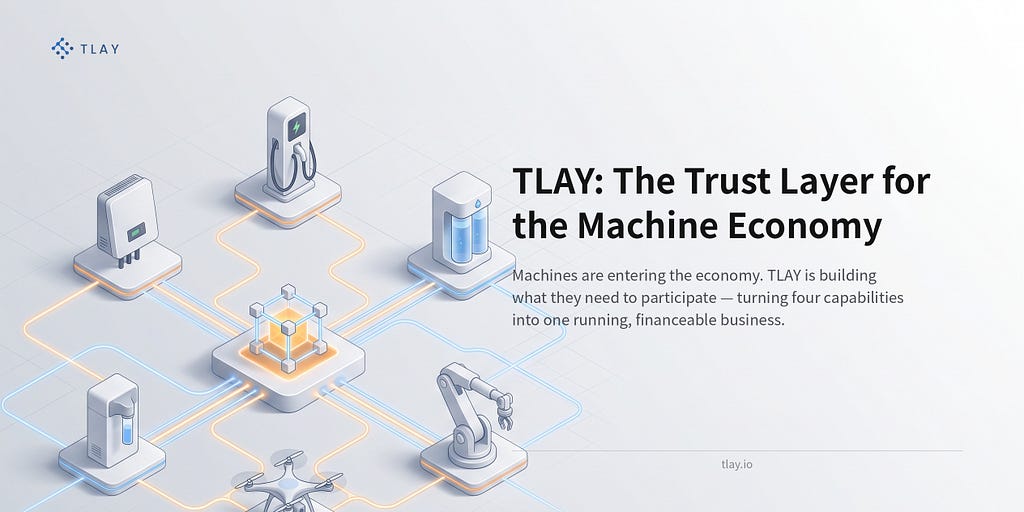
A solar inverter exports power every afternoon. A water purifier dispenses thousands of litres a month. A charging stall delivers energy by the kilowatt-hour. Each one is, by any honest accounting, already a productive economic engine. It senses, it decides, it acts — and it creates real value, continuously.
And yet none of these machines can participate in the economy as a first-class entity.
They cannot natively own an identity. They cannot prove, to anyone who wasn’t standing next to them, what they actually did. They cannot price a service, collect for it, and settle — without a human account, a platform, or a cloud API standing in the middle. The machine works. The business belongs to someone else.
This is the gap TLAY exists to close.
1. The machine economy has arrived without its economy
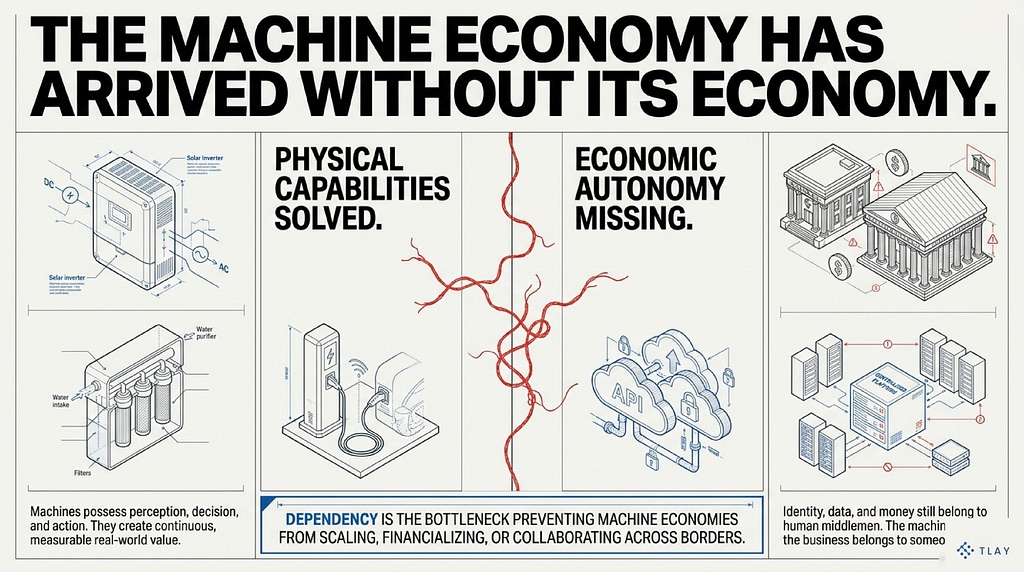
AI, robotics, energy devices, and autonomous systems are moving into the physical world at scale. Their physical capabilities — perception, decision, action — are solved. What is missing is the one capability that turns a machine into an economic participant: economic autonomy.
Today, every unit of machine value still has to be mediated by centralized platforms, human bank accounts, and cloud services. A machine can do the work, but the identity, the data, the money, and the financing all belong to an intermediary. That dependency is the real bottleneck — the reason machine economies cannot truly scale, financialize, or collaborate across borders.
The next phase of the economy is not people using machines. It is machines acting as autonomous economic participants. For that to happen, machines need native economic primitives — embedded at the device level, not bolted on through platforms and APIs.
2. TLAY’s mission: a trust layer for intelligent machines
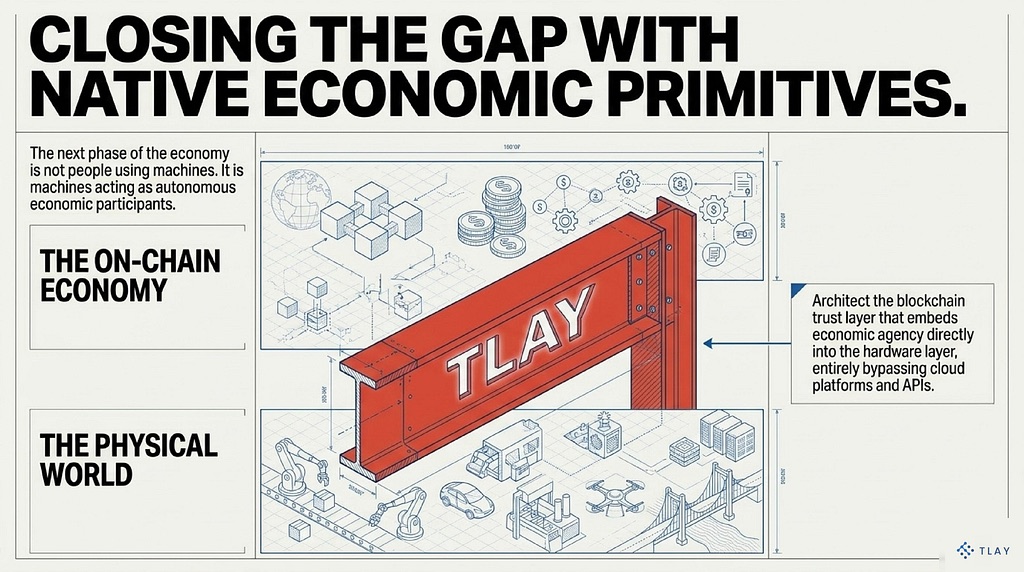
TLAY is building the blockchain trust layer for the machine economy. Its mission is not to ship one more application; it is to architect the economic primitives a machine needs to act in the economy directly — and to embed trust and economic agency into the hardware layer itself.
At the heart of TLAY is BoAT (Blockchain of AI Things) — not a wallet app, but a lightweight, embedded machine-economic runtime. BoAT runs directly on IoT chips, robots, and energy devices; it is written for resource-constrained hardware; it is chain-neutral and hardware-neutral; and crucially, the private key lives on the edge device, not on a central server. BoAT is how a machine enters the on-chain economy — natively, at the source.
But a runtime that gives a machine its primitives is only half the story. Primitives have to become a business.
3. The four capabilities: TLAY’s Value Stack
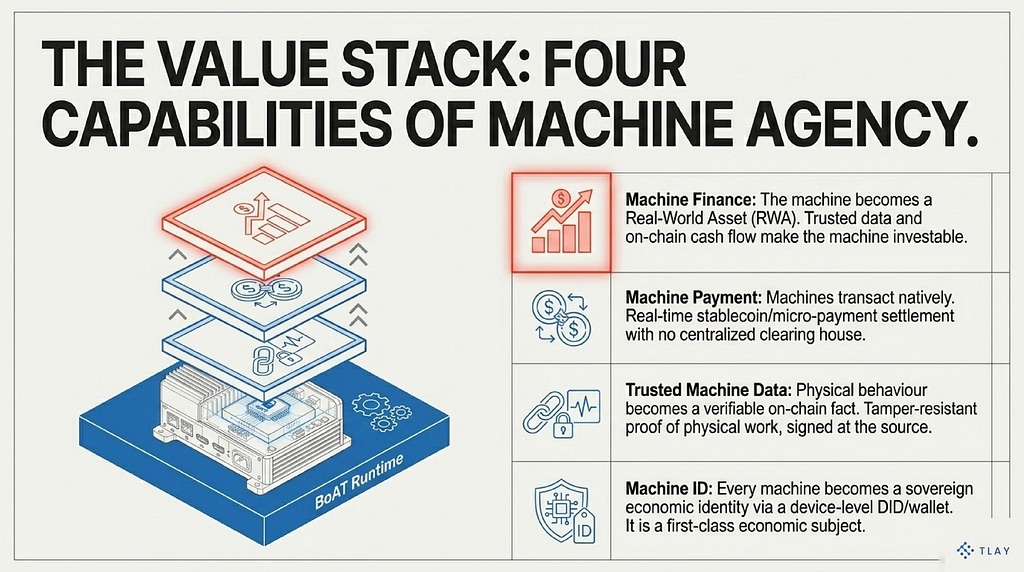
Through BoAT, TLAY unlocks four capabilities that together transform a machine into an economic actor. Value accrues up the stack.
- Machine ID — every machine becomes a sovereign economic identity. A device-level DID and wallet, unforgeable and native to the hardware, no longer borrowed from a human account, a platform sub-account, or a cloud API key. The machine becomes a first-class economic subject.
- Trusted Machine Data — physical behaviour becomes a verifiable on-chain fact. Sensor data, operational logs, and proof of physical work are signed at the source and anchored on-chain: tamper-resistant, auditable, and bound to the machine’s identity. Trust stops being abstract; it is measured at the source.
- Machine Payment — machines transact natively. Stablecoins, micro-payments, and real-time settlement, machine-to-machine and machine-to-protocol, with no centralized clearing house in the path. Payment becomes a native machine capability, not an API call.
- Machine Finance — machines become investable. When a machine owns identity, trusted data, and on-chain cash flow, it becomes a Real-World Asset and a DePIN-grade financial unit, with revenue distributable on-chain. The machine moves from operating to financial.
This is the foundation, and it matters. But a stack of capabilities is not yet a running business. Four primitives sitting side by side are four parts in a box. An identity that never authorises an action is inert. Signed data that never settles a payment is just a tamper-proof log. What turns TLAY’s capabilities into commerce is orchestration— wiring all four into a single loop that runs every time the machine does something worth money.
4. From capabilities to commerce: one running loop
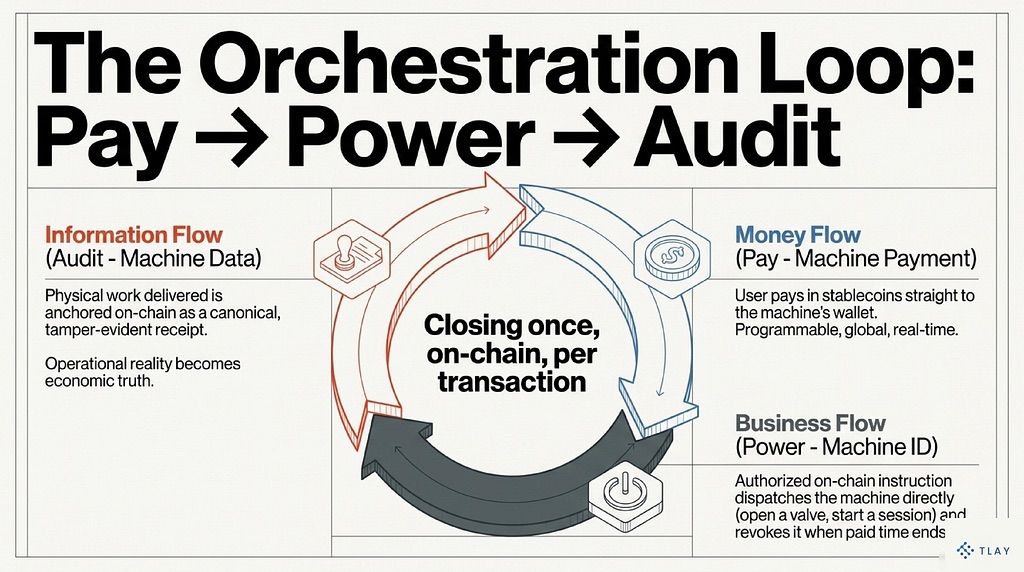
This is where TLAY’s capabilities stop being a stack and start being a business. The connective layer that strings the four primitives together is the Machine Commerce Enabler — the part of TLAY that takes Machine ID, Machine Data, and Machine Payment and closes them into one automatic loop, so a real machine can transact, operate, and be financed natively on-chain.
It does this by moving the three flows of any machine-based business on-chain — each flow powered by one of TLAY’s capabilities:
- Business flow, on Machine ID. Because the machine has an on-chain identity, an authorised on-chain instruction dispatches it directly — open a valve, energise a circuit, start a session — and revokes that right just as directly when the paid period ends. The business is run on-chain, not merely recorded there.
- Information flow, on Machine Data. Each unit of physical work — energy exported, litres dispensed, a session served — is signed and anchored on-chain as a canonical, tamper-evident receipt. Anyone who was never near the device can verify that the work happened and that this machine did it. Operational reality becomes economic truth.
- Money flow, on Machine Payment. Every pay-as-you-go service settles as a stablecoin payment, on-chain, straight into the machine’s wallet or its operator’s address. Stablecoins are the natural unit for machine commerce: global, programmable, divisible to the micro-payment, real-time — with no central bank or cloud proxy in the path.
In practice the loop has a simple shape: pay → power → audit. A user pays in stablecoins; the machine is commanded on-chain to deliver; the delivery is attested, anchored, and made independently verifiable. Money flow, business flow, and information flow — closing once, on-chain, per transaction. TLAY’s primitives, finally working as one.
5. When the loop closes, Machine Finance ignites
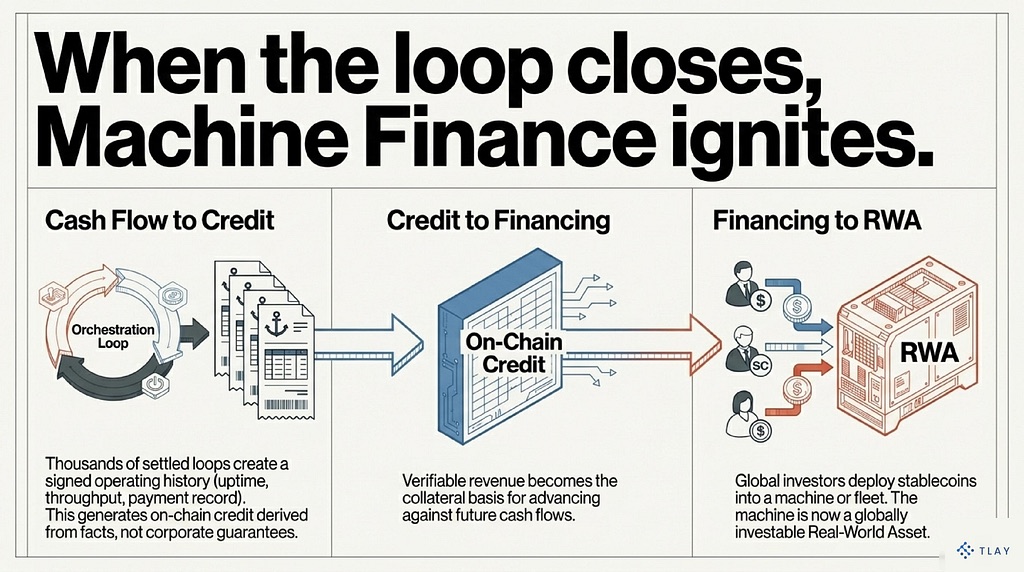
A single closed loop is a sale. Thousands of them, signed and settled, are something much larger: a financial track record that belongs to the machine.This is TLAY’s fourth capability — Machine Finance — realized, and it arrives as a consequence of the loop, not a separate product.
It runs in three steps:
From cash flow to on-chain credit. Each machine accumulates a verifiable, stablecoin-denominated cash flow and a signed operating history — uptime, throughput, delivered work, payment record. None of it rests on a corporate guarantee or a platform’s word; it rests on facts signed at the source. That record is, in effect, the machine’s on-chain credit— creditworthiness derived from what the machine demonstrably did, not from who owns it.
From on-chain credit to financing. Once a machine has on-chain credit, it can be financed against it. Its verifiable revenue and operating history become the collateral basis for on-chain financing— advancing against future cash flows, with the credit coming from the chain itself rather than off-chain underwriting. A machine that can prove it earns can borrow against its earning.
From financing to stablecoin RWA. That financing is denominated and settled in stablecoins: global investors deploy stablecoins into a machine or a fleet, and the returns — also in stablecoins — are distributed automatically according to on-chain cash flow. The machine becomes a Real-World Asset that anyone, anywhere, can fund and earn from.
So TLAY’s full arc becomes concrete: every service settles into stablecoins, the stablecoin cash flow hardens into on-chain credit, and on-chain credit opens into stablecoin financing. A machine moves from doing work to being financialised by global capital— without ever leaving the chain.
6. Trust you can grade, a loop you can repeat
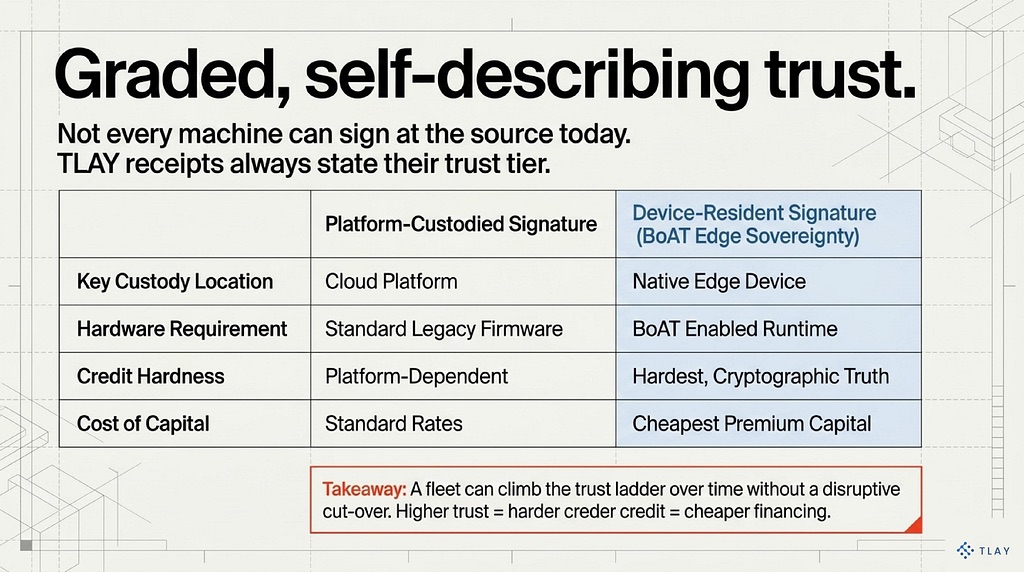
Two properties keep this from being a slide and make it an operating system for the machine economy.
Graded, self-describing trust. Not every machine in the field can sign on-chain at the source yet. So the trust in each on-chain fact is graded and stated on the receipt itself: a platform-custodied signature for machines whose firmware can’t yet hold a key, and a device-resident signature — BoAT’s edge sovereignty — for machines that sign at the edge with full autonomy. The receipt always declares its tier. This has direct financial meaning: a higher trust tier means harder on-chain credit, which means cheaper financing. A fleet can climb the trust ladder over time, all the way to full machine sovereignty, without a disruptive cut-over.
One loop, any machine.The loop is not built for one kind of device. Pricing logic, the control adapter that drives the hardware, and the unit of service are all pluggable. A new machine business is assembledfrom the same core, not forked from it — the identical orchestration already runs across more than one physical vertical, with no change to the core. This is the mechanism by which the machine economy expands: prove the loop in one domain, then re-use it in the next — energy, then utilities, then mobility, then anything that does measurable physical work.
7. SOME: the Smart Open Machine Economy
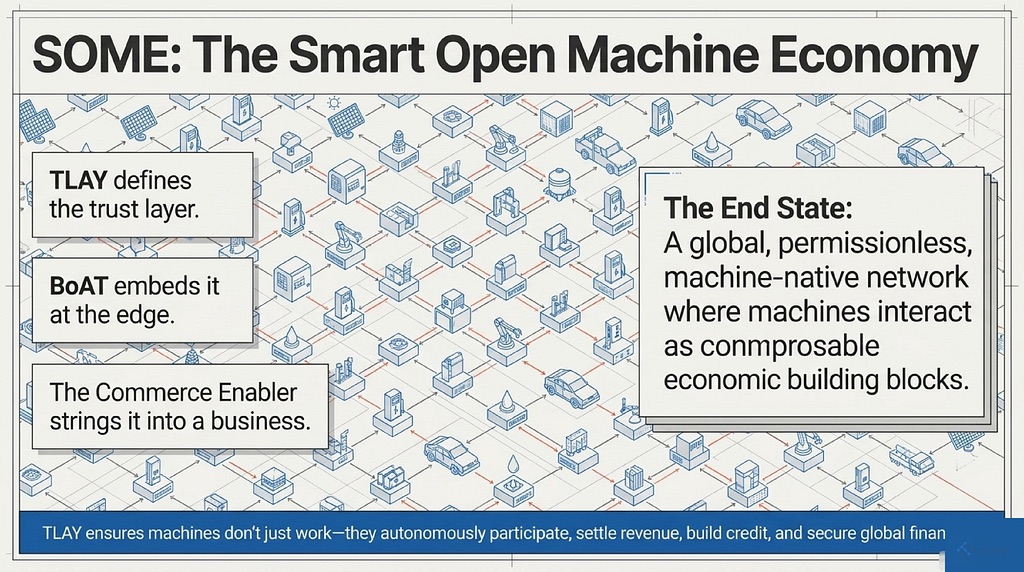
Stand back, and TLAY’s layers line up cleanly:
- TLAY defines the vision and the trust layer — what a machine must be able to do to act as an economic entity.
- BoAT puts those primitives on the machine — wallet, identity, signing, at the edge.
- The Machine Commerce Enabler strings the primitives into a running business — closing the business, information, and money flows into one on-chain loop, and turning the resulting cash flow into on-chain credit and stablecoin finance.
Each machine that comes online this way is no longer hardware whose value is captured by a platform. It is an autonomous economic node: it runs its own operations on-chain, settles its own revenue in stablecoins, builds its own credit, and can be financed by anyone in the world.
Multiply that by every energy device, utility, vehicle, and robot doing real work — coordinating through open protocols instead of centralized platforms — and the end state TLAY is built for comes into view: the Smart Open Machine Economy (SOME) — global, permissionless, machine-native, and composable, where machines interact like economic building blocks.
TLAY is building the trust layer for the machine economy. BoAT gives machines wallets, identities, and the right to transact. The Machine Commerce Enabler turns those capabilities into a running, financeable business. Together, they bring a truly open Smart Open Machine Economy into reality— machines that don’t just work, but participate.