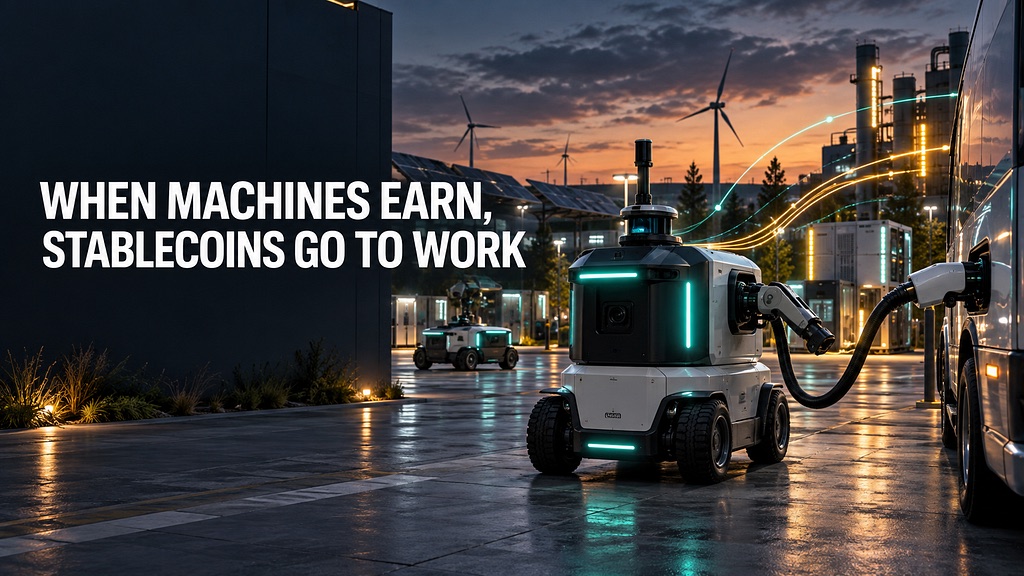
Consider an operator running a fleet of charging robots. Each robot travels to a customer, delivers electricity, records the amount supplied, and earns a fee. Between jobs, it consumes energy, needs maintenance, and occasionally purchases software or remote assistance.
Now suppose demand exceeds the fleet’s capacity. The operator knows where additional machines could work and has a history of customers paying for the service. Expansion still requires money upfront. Robots must be purchased, deployed, and maintained before their future revenue arrives.
This is where the machine economy meets a familiar economic problem: productive assets need capital.
As Physical AI becomes capable of performing more useful work, financing the machines that deliver it will become an important part of bringing that work into the economy. Stablecoins could connect the capital that deploys a machine with the income it subsequently generates. Machine infrastructure could make the relationship between those two flows easier to observe and verify.
At TLAY, we believe that connection deserves a central place in the discussion about the agentic economy.
An agent’s ability to pay for a service is useful. A machine’s ability to earn revenue, purchase resources, and establish a record that a financing provider can evaluate opens a much broader field of economic activity.
Physical machines bring their own capital requirements. A charging unit needs hardware and installation. A water dispenser needs equipment, filters, and servicing. A distributed energy system needs panels, batteries, and a functioning local operation. A robot needs a deployment environment in which its work has a buyer.
Even when software makes those systems more capable, expansion remains tied to procurement, logistics, working capital, and maintenance. Better intelligence can increase the value of a machine’s work while also increasing demand for the capital needed to deploy more machines.
For an operator, this changes the reason to adopt economic infrastructure. A programmable wallet can make payments easier. A reliable operating record, connected to orders and receipts, could also help the business demonstrate why it deserves financing.
The practical question becomes: can the earnings of existing machines help an operator obtain the capital to deploy the next ones?
Stablecoins offer a possible connection across that process. Imagine a financing provider advancing a dollar-denominated stablecoin to an operator. The operator purchases equipment from a supplier that accepts it. Once deployed, the machines sell useful services and generate revenue in the same stablecoin. The operator uses that revenue to cover costs, meet repayment obligations, and reinvest in additional capacity.
Capital enters through financing. Machines turn that capital into productive capacity. Customers pay for the output. Revenue supports repayment and further investment.
The same settlement asset could move through several stages of the business: financing, procurement, operating income, debt service, and reinvestment. Each transfer would have a commercial purpose connected to a machine doing useful work.
The currency of income matters. When a business earns revenue in the same stablecoin used for repayment, it can reduce the conversion steps between receiving income and meeting its obligations. If its prices remain tied to a local currency, however, the underlying currency exposure can persist even when payment arrives in a dollar-denominated token. The economics depend on how services are priced, how costs are incurred, and how debt is structured.
Keeping a machine productive also requires careful allocation of revenue. Electricity, maintenance, taxes, and operating reserves must be funded alongside repayment. A financing arrangement that leaves too little money to maintain the asset can weaken the very income stream on which repayment depends.
A useful stablecoin loop must therefore reflect the operating business. It needs room for expenses, interruptions, seasonal demand, and reinvestment.
That is also why moving money is only part of the infrastructure challenge. A financing provider needs to understand what the money is funding and what can reasonably repay it.
A wallet balance reveals little about the condition of a charging robot. A payment confirms that value moved, but it does not establish that the corresponding service was delivered. Revenue can come from real customers, related parties, temporary subsidies, or transactions designed to create the appearance of activity.
The lender needs a more complete picture: which machines exist, who owns and operates them, whether they are working, what services they deliver, who pays, and how much cash remains after the costs of running the business. Existing obligations and the ability to recover value if the business fails matter as well.
Machine data can contribute to that picture. Utilization, energy delivery, downtime, maintenance events, completed orders, refunds, and receipts can help explain the operating activity behind reported revenue. Their value increases when records have identifiable sources and can be checked against one another.
For example, an energy delivery record, a customer order, and a payment should refer to the same service. A sudden drop in receipts should be interpretable alongside device availability and usage. A claim that new equipment has entered operation should connect to procurement and deployment evidence.
The opportunity is to make machine operations legible to capital.
This has to extend beyond collecting more telemetry. Financing requires evidence that someone can use to make a decision, monitor an exposure, and act within an agreed set of rights and responsibilities.
A device signature establishes that a particular key signed a statement. An anchored record can help establish that the statement has not subsequently been altered. The truth of a physical measurement still depends on the sensor, its calibration, the device’s security, and, where needed, independent checks. A complete credit assessment also requires information beyond the machine.
Similarly, observing income does not guarantee control over repayment. An operator may collect some revenue elsewhere. A loan agreement, an authorized collection arrangement, and a reconciliation process each perform work that a cryptographic receipt cannot do alone.
These distinctions guide the economic infrastructure we are building at TLAY.
BoAT provides machine-side identity, signing, and controlled economic authority. HashAnchor provides mechanisms for turning records into portable, tamper-evident receipts. Through the Machine Commerce Enabler, we aim to connect those capabilities to service descriptions, orders, execution, measurement, and payments.
Together, these capabilities could help a machine participate in commerce and leave an operating history that counterparties can examine. That history could become an input to underwriting and ongoing monitoring. Connecting a device would establish a source of evidence; financing eligibility would still depend on the quality of the business, the asset, and the proposed arrangement.
A durable machine economy needs records that remain useful across organizational boundaries. An operator should be able to share appropriate evidence with a financing provider without asking that provider to accept every claim in a private dashboard. A buyer should be able to retain a service receipt and check it independently. Different applications should be able to use a common record without all depending on the same database.
That portability creates room for competition among service providers, financing institutions, and tools for evaluating risk. TLAY’s role is to make the underlying activity easier to connect and verify, while lenders retain responsibility for credit decisions and operators remain responsible for their businesses. This infrastructure should work across payment ecosystems, allowing operators and financing providers to choose the settlement assets and services that fit their needs.
The payment and service layers would need to support both sides of the market. Buyers need a way to discover services, understand their terms, and spend within defined budgets. Machine operators need a way to publish capabilities, quote prices, accept payments, and report delivery. Shared interfaces could make it easier for different wallets, agent frameworks, and equipment platforms to participate.
A machine service integration could extend those capabilities into physical commerce. An agent could discover a machine’s service, evaluate its terms, and pay for access. The machine’s operating system and commercial interfaces would handle delivery, while device records and receipts would connect the payment to the work performed.
Over time, that activity could also provide evidence for financing the operator behind the machines. Funding could come from banks, equipment finance companies, credit funds, or other appropriately structured providers. Stablecoin issuance, payment infrastructure, and credit provision can be supplied by different organizations. The operator remains the borrower, with machines serving as productive assets and sources of operating evidence.
For stablecoin issuers and payment networks, the strategic opportunity is broader use throughout a productive business. Financing can introduce an operator to a settlement asset. Supplier acceptance can extend its use into procurement. Customers paying for machine services can create recurring receipts. Operators retaining working balances can use those receipts to purchase resources, repay financing, and expand.
Each stage creates a reason for another participant to use the currency. A supplier may pay a service provider. An operator may buy electricity or inference. A financing provider may receive repayments and allocate capital to another productive operation.
The result could be a network of businesses using stablecoins across several parts of their economic activity, with connections between currencies and payment systems where needed.
That network will have to earn adoption. Suppliers need a reason to accept stablecoin payments. Customers need a practical way to obtain and spend the accepted currency. Operators need reliable access to the currencies in which they pay local expenses. If every recipient immediately converts out, stablecoins may still serve a valuable financing or settlement function, but circulation within day-to-day operations will be more limited.
The measures of progress should reflect those differences. Useful evidence includes real commercial payments, recurring customers, operating balances, subsequent purchases, and repayments funded by business income. The same dollars moving repeatedly between related wallets reveal very little about whether productive activity is growing. Lending existing stablecoins also does not, by itself, create new issuance or increase their outstanding supply.
The stronger case is that machines create reasons for people and businesses to obtain, hold, and use digital dollars over time.
Financing and infrastructure adoption could then reinforce each other. An operator seeking expansion capital has a reason to establish a more reliable operating record. A financing provider has a reason to support interfaces that reduce the work of reviewing and monitoring that record. Additional capital can fund additional productive machines, whose performance generates new evidence and, if the business succeeds, new revenue.
This is a feedback loop worth testing carefully. More connected devices will not automatically produce better loans. Financing demand can be strongest among businesses with the weakest alternatives, and standardized data can carry standardized errors. The quality of customers, assets, and underwriting remains decisive.
The most credible starting point is an operator with existing revenue, known equipment, and a specific need for capital. A financing provider should help define the information it needs before the infrastructure team builds a large reporting system. The first deployment can then test whether connected operating records improve a real financing assessment and make subsequent monitoring more useful.
For TLAY, an initial machine service integration is a practical step toward that larger objective. A paid device data service can establish discovery, payment, and receipt verification. A subsequent charging or robotic service can add physical execution and measurement. A financing pilot can connect an actual operator’s operating history with an actual capital provider’s requirements. Each step should produce evidence that justifies the next.
Physical AI gives machines new ways to perform work. Economic infrastructure can help their owners organize that work into services, income, expenditure, and investment. Financing connects today’s capital to the productive capacity those machines may provide tomorrow.
The case for deploying another charging robot begins with a business that works: customers value the service, revenue covers its costs, and the operator can demonstrate that performance. Stablecoins could carry value through that entire journey, from purchasing the robot to collecting its income and financing the next one.
Machine finance can bring stablecoins into production. Machine income can give them a reason to keep circulating.
At TLAY, we are building the infrastructure to connect those two ends of the machine economy.